Advertisements
Advertisements
प्रश्न
Find the missing value.
| Diagonal (d1) | Diagonal (d2) | Area |
| 12 mm | 180 sq.mm |
Advertisements
उत्तर
Given diagonal d2 = 12 mm; Area of the rhombus = 180 sq.m
`1/2` (d1 × d2) = 180
`1/2` (d1 × 12) = 180
d1 × 12 = 180 × 2
d1 = `(180 xx 2)/12`
d1 = 30 mm
Diagonal d1 = 30 mm
Tabulating the results we have
| Diagonal (d1) | Diagonal (d2) | Area |
| 30 mm | 12 mm | 180 sq.mm |
APPEARS IN
संबंधित प्रश्न
If perimeter of a rhombus is 100 cm and length of one diagonal is 48 cm, what is the area of the quadrilateral?
The diagonals of a rhombus are 18 cm and 24 cm. Find:
(i) its area ;
(ii) length of its sides.
(iii) its perimeter
The area of a rhombus is equal to the area of a triangle. If the base ∆ is 24 cm, its corresponding altitude is 16 cm and one of the diagonals of the rhombus is 19.2 cm. Find its other diagonal.
The area of the rhombus when both diagonals measuring 8 cm is
The area of the rhombus is 128 sq.cm and the length of one diagonal is 32 cm. The length of the other diagonal is
The height of the rhombus whose area 96 sq.m and side 24 m is
The area of the rhombus is 576 sq.cm and the length of one of its diagonal is half of the length of the other diagonal then find the length of the diagonal
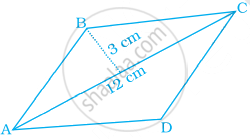
The figure ABCD is a quadrilateral in which AB = CD and BC = AD. Its area is ______.
If the diagonals of a rhombus get doubled, then the area of the rhombus becomes ______ its original area.
The area of a rectangular field is 48 m2 and one of its sides is 6 m. How long will a lady take to cross the field diagonally at the rate of 20 m/minute?
