Advertisements
Advertisements
Question
If perimeter of a rhombus is 100 cm and length of one diagonal is 48 cm, what is the area of the quadrilateral?
Advertisements
Solution
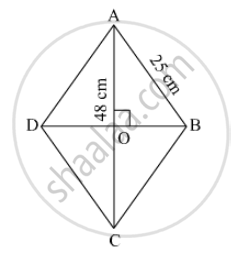
Perimeter of the rhombus = 100 cm
⇒ `4 xx` side = 100
⇒ side = `100/4` = 25 cm
Thus, each side of the rhombus = 25 cm.
Diagonals of a rhombus are perpandicular bisector of each other.
So, AO = OC = `48/2` = 24 cm
In Δ AOB,
We apply Pythagoras theorem,
AO² + OB² = AB²
⇒ 24² + OB² = 25²
⇒ OB² = 625 - 576 = 49
⇒ OB = 7 cm
So, DB = `2 xx "OB" = 2 xx 7` = 14 cm
Area of rhombus = `1/2 xx` (product of diagonal)
= `1/2 xx 14 xx 48`
= 336 cm²
RELATED QUESTIONS
If length of a diagonal of a rhombus is 30 cm and its area is 240 sq cm, find its perimeter.
The perimeter of a rhombus is 40 cm. If one diagonal is 16 cm; find:
- It's other diagonal
- area
Find the area of rhombus PQRS shown in the following figure.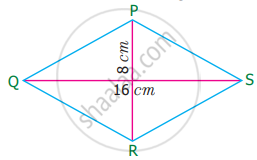
Find the area of rhombus PQRS shown in the following figure.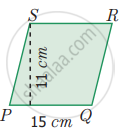
Find the missing value.
| Diagonal (d1) | Diagonal (d2) | Area |
| 19 cm | 16 cm |
Find the missing value.
| Diagonal (d1) | Diagonal (d2) | Area |
| 26 m | 468 sq.m |
The area of the rhombus is 128 sq.cm and the length of one diagonal is 32 cm. The length of the other diagonal is
The height of the rhombus whose area 96 sq.m and side 24 m is
A man has to build a rhombus shaped swimming pool. One of the diagonal is 13 m and the other is twice the first one. Then find the area of the swimming pool and also find the cost of cementing the floor at the rate of ₹ 15 per sq.cm
The walls and ceiling of a room are to be plastered. The length, breadth and height of the room are 4.5 m, 3 m, and 350 cm respectively. Find the cost of plastering at the rate of Rs 8 per m2.
