Advertisements
Advertisements
Question
Lengths of the diagonals of a rhombus are 16.5 cm and 14.2 cm, find its area.
Advertisements
Solution
Lengths of the diagonals of a rhombus are 16.5 cm and 14.2 cm.
Area of rhombus = `1/2 xx "product of lengths of diagonals"`
Area of rhombus = `1/2 xx 16.5 xx 14.2`
= 16.5 × 7.1
= 117.15 cm2
∴ The area of the rhombus is 117.15 sq. cm.
RELATED QUESTIONS
Lengths of the diagonals of a rhombus are 15 cm and 24 cm, find its area.
If length of a diagonal of a rhombus is 30 cm and its area is 240 sq cm, find its perimeter.
The diagonals of a rhombus are 18 cm and 24 cm. Find:
(i) its area ;
(ii) length of its sides.
(iii) its perimeter
The length of the diagonals of a rhombus is in ratio 4 : 3. If its area is 384 cm2, find its side.
Find the area of a rhombus whose base is 14 cm and height is 9 cm.
The area of the rhombus is 128 sq.cm and the length of one diagonal is 32 cm. The length of the other diagonal is
The angle between the diagonals of a rhombus is
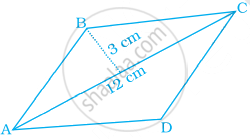
The figure ABCD is a quadrilateral in which AB = CD and BC = AD. Its area is ______.
Area of a quadrilateral ABCD is 20 cm2 and perpendiculars on BD from opposite vertices are 1 cm and 1.5 cm. The length of BD is ______.
The walls and ceiling of a room are to be plastered. The length, breadth and height of the room are 4.5 m, 3 m, and 350 cm respectively. Find the cost of plastering at the rate of Rs 8 per m2.
