Advertisements
Advertisements
Question
The diagonals of a rhombus are 18 cm and 24 cm. Find:
(i) its area ;
(ii) length of its sides.
(iii) its perimeter
Advertisements
Solution
The diagonal of the rhombus is 18 cm and 24 cm.
area of rhombus = `1/2` x Product of diagonals
= `1/2` x 18 x 24
= 216 cm2
(ii)
Diagonals of a rhombus bisect each other at right angles.
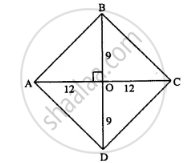
∴ OA = `1/2 xx 24 = 12` cm
OB = `1/2 xx 18 = 9` cm
In right ∠d Δ AOB
AB = `sqrt("OA"^2 + "OB"^2)`
= `sqrt((12)^2 + (9)^2)`
= `sqrt(144 + 81)`
= `sqrt(225) = 15` cm
∴ Side of rhombus = 15 cm
(iii)
Perimeter of rhombus = `4 xx "side"`
= `4 xx 15 = 60` cm
(i) 216 cm2 (ii) 15 cm (iii) 60 cm.
APPEARS IN
RELATED QUESTIONS
If perimeter of a rhombus is 100 cm and length of one diagonal is 48 cm, what is the area of the quadrilateral?
Each side of a rhombus is 18 cm. If the distance between two parallel sides is 12 cm, find its area.
Find the missing value.
| Diagonal (d1) | Diagonal (d2) | Area |
| 19 cm | 16 cm |
Find the missing value.
| Diagonal (d1) | Diagonal (d2) | Area |
| 26 m | 468 sq.m |
Find the missing value.
| Diagonal (d1) | Diagonal (d2) | Area |
| 12 mm | 180 sq.mm |
The area of the rhombus when both diagonals measuring 8 cm is
The area of the rhombus is 576 sq.cm and the length of one of its diagonal is half of the length of the other diagonal then find the length of the diagonal
Area of a rhombus = `1/2` product of ______.
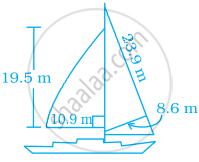
Most of the sailboats have two sails, the jib and the mainsail. Assume that the sails are triangles. Find the total area sail of the sailboats to the nearest tenth.