Advertisements
Advertisements
Question
The adjacent sides of a parallelogram are 21 cm and 28 cm. If it's one diagonal is 35 cm; find the area of the parallelogram.
Advertisements
Solution
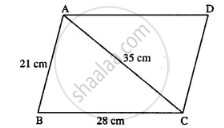
First, we find the area of ΔABC.
Sides are, a = 28 cm
b = 35 cm
and c = 21 cm
S = `(a + b + c)/2`
= `(28 + 35 + 21)/2`
= `84/2 = 42` cm
area of ΔABD = `sqrt(S(S - a)(S - b)(S - c))`
= `sqrt(42(42 - 28)(42 - 35)(42 - 21))`
= `sqrt(42 xx 14 xx 7 xx 21)`
= `sqrt(2 xx 21 xx 2 xx 7 xx 7 xx 21)`
= `sqrt(2 xx 2 xx 21 xx 21 xx 7 xx 7)`
= `2 xx 21 xx 7`
= 294 cm2
∵ Diagonal of ||gm divides it into two equal parts.
∴ area of ||gm = `2 xx "area of ΔABC"`
= 2 × 294
= 588 cm2
APPEARS IN
RELATED QUESTIONS
Find the missing value:
| Base | Height | Area of parallelogram |
| 20 cm | ______ | 246 cm2 |
If base of a parallelogram is 18 cm and its height is 11 cm, find its area.
A parallelogram has sides of 20 cm and 30 cm. If the distance between its shorter sides is 15 cm; find the distance between the longer sides.
In a parallelogram the base is three times its height. If the height is 8 cm then the area is
The area of the parallelogram ABCD is 1470 sq.cm. If AB = 49 cm and AD = 35 cm then, find the height, DF and BE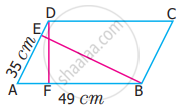
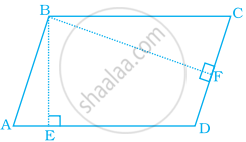
Area of parallelogram ABCD (see the figure) is not equal to ______.
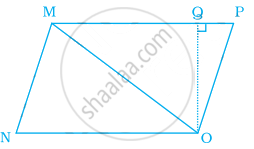
Ratio of area of ∆MNO to the area of parallelogram MNOP in the same figure is ______.
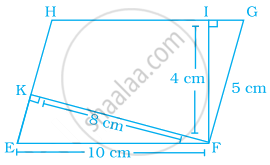
In the following figure, EFGH is a parallelogram, altitudes FK and FI are 8 cm and 4 cm respectively. If EF = 10 cm, then area of EFGH is ______.
Perpendicular dropped on the base of a parallelogram from the opposite vertex is known as the corresponding ______ of the base.
If perimeter of two parallelograms are equal, then their areas are also equal.
