Advertisements
Advertisements
Question
Find the missing values.
| Base | Height | Area |
| 17 mm | 221 sq.mm |
Advertisements
Solution
Given: Height h = 17 mm
Area of the parallelogram = 221 sq.mm
b × h = 221
b × 17 = 221
b = `221/17`
b = 13 m
Tabulating the results, we get
| Base | Height | Area |
| 13 m | 17 mm | 221 sq.mm |
APPEARS IN
RELATED QUESTIONS
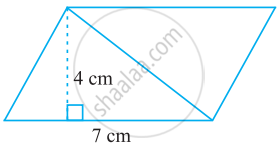
Find the area of the following parallelogram:
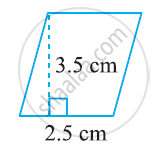
Find the area of the following parallelogram:
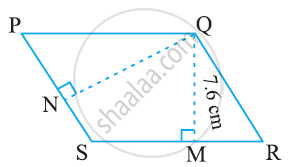
PQRS is a parallelogram (see the given figure). QM is the height from Q to SR and QN is the height from Q to PS. If SR = 12 cm and QM = 7.6 cm. Find:
- the area of the parallelogram PQRS
- QN, if PS = 8 cm
The base of the parallelogram with area is 52 sq.cm and height 4 cm is
What happens to the area of the parallelogram if the base is increased 2 times and the height is halved?
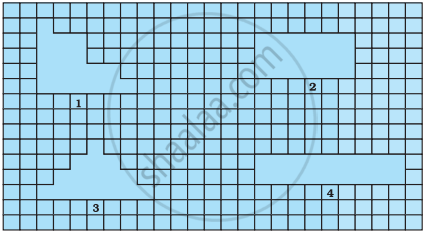
Observe the shapes 1, 2, 3 and 4 in the figures. Which of the following statements is not correct?
If the sides of a parallelogram are increased to twice its original lengths, how much will the perimeter of the new parallelogram?
In the following figure, area of parallelogram BCEF is ________ cm2 where ACDF is a rectangle.

If perimeter of two parallelograms are equal, then their areas are also equal.
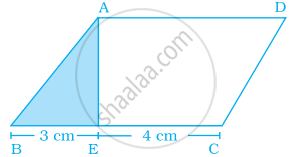
In the following figure, find the area of parallelogram ABCD if the area of shaded triangle is 9 cm2.