Advertisements
Advertisements
Question
What happens to the area of the parallelogram if the base is increased 2 times and the height is halved?
Options
Decreases to half
Remains the same
Increase by two times
None
Advertisements
Solution
Remains the same
Explanation;
Hint:
Area = b × h sq.units
New base = 2 × old base
New height = `1/2` × old height
New Area = New base × New height
= `(2 xx "b")1/2 xx "h"`
= bh
= old Area
APPEARS IN
RELATED QUESTIONS
Find the missing value:
| Base | Height | Area of parallelogram |
| 20 cm | ______ | 246 cm2 |
A parallelogram has sides of 20 cm and 30 cm. If the distance between its shorter sides is 15 cm; find the distance between the longer sides.
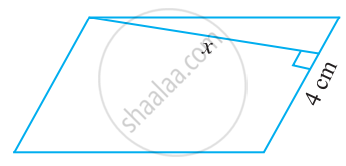
Find the height ‘x’ if the area of the parallelogram is 24 cm2 and the base is 4 cm.
Janaki has a piece of fabric in the shape of a parallelogram. Its height is 12 m and its base is 18 m. She cuts the fabric into four equal parallelograms by cutting the parallel sides through its mid-points. Find the area of each new parallelogram
A square and a parallelogram have the same area. If the side of the square is 48 m and the height of the parallelogram is 18 m. Find the length of the base of the parallelogram
In a parallelogram PQRS (See the diagram) PM and PN are the heights corresponding to the sides QR and RS respectively. If the area of the parallelogram is 900 sq.cm and the length of PM and PN are 20 cm and 36 cm respectively, find the length of the sides QR and SR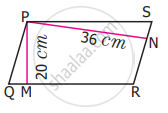
Find the height of the parallelogram whose base is four times the height and whose area is 576 sq.cm
To find area, any side of a parallelogram can be chosen as ______ of the parallelogram.
If perimeter of two parallelograms are equal, then their areas are also equal.
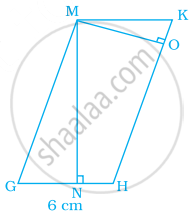
Altitudes MN and MO of parallelogram MGHK are 8 cm and 4 cm long respectively (see figure). One side GH is 6 cm long. Find the perimeter of MGHK.