Advertisements
Advertisements
Question
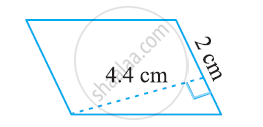
Find the area of the following parallelogram:
Advertisements
Solution
Area of parallelogram = Base × Height
Height = 4.4 cm
Base = 2 cm
Area of parallelogram = 2 × 4.4
= 8.8 cm2
RELATED QUESTIONS
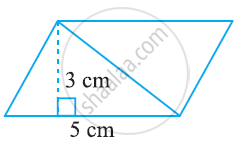
Find the area of the following parallelogram:
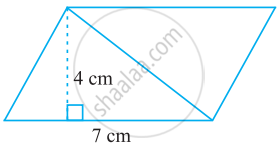
Find the area of the following parallelogram:
Find the missing value:
| Base | Height | Area of parallelogram |
| 20 cm | ______ | 246 cm2 |
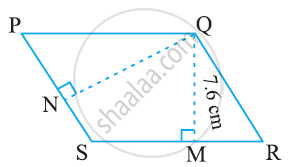
PQRS is a parallelogram (see the given figure). QM is the height from Q to SR and QN is the height from Q to PS. If SR = 12 cm and QM = 7.6 cm. Find:
- the area of the parallelogram PQRS
- QN, if PS = 8 cm
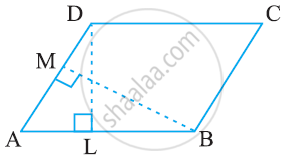
DL and BM are the heights on sides AB and AD respectively of parallelogram ABCD (see the given figure). If the area of the parallelogram is 1470 cm2, AB = 35 cm and AD = 49 cm, find the length of BM and DL.
A ground is in the shape of parallelogram. The height of the parallelogram is 14 metres and the corresponding base is 8 metres longer than its height. Find the cost of levelling the ground at the rate of ₹ 15 per sq.m
In a parallelogram the base is three times its height. If the height is 8 cm then the area is
The base of the parallelogram is 16 cm and the height is 7 cm less than its base. Find the area of the parallelogram
A square and a parallelogram have the same area. If the side of the square is 48 m and the height of the parallelogram is 18 m. Find the length of the base of the parallelogram
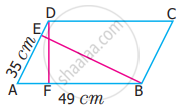
The area of the parallelogram ABCD is 1470 sq.cm. If AB = 49 cm and AD = 35 cm then, find the height, DF and BE