Advertisements
Advertisements
Question
The base of the parallelogram is 16 cm and the height is 7 cm less than its base. Find the area of the parallelogram
Advertisements
Solution
In a parallelogram
Given base b = 16 cm, height h = base – 7 cm
= 16 – 7
= 9 cm
Area of the parallelogram = (base × height) sq.units
= 16 × 9 cm2
= 144 cm2
Area of the parallelogram = 144 cm2
APPEARS IN
RELATED QUESTIONS
Find the area of the following parallelogram:
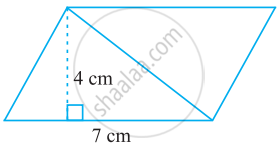
Find the area of the following parallelogram:
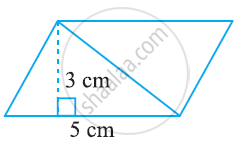
Find the area of the following parallelogram:
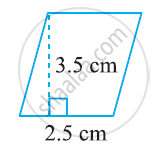
Find the missing values.
| Base | Height | Area |
| 8 cm | 56 sq.m |
Suresh on a parallelogram-shaped trophy in a state level chess tournament. He knows that the area of the trophy is 735 sq.cm and its base is 21 cm. What is the height of that trophy?
Janaki has a piece of fabric in the shape of a parallelogram. Its height is 12 m and its base is 18 m. She cuts the fabric into four equal parallelograms by cutting the parallel sides through its mid-points. Find the area of each new parallelogram
If the base and height of a parallelogram are in the ratio 7 : 3 and the height is 45 cm, then fixed the area of the parallelogram
Find the area of the parallelogram ABCD if AC is 24 cm and BE = DF = 8 cm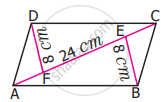
In the following figure, area of ∆AFB is equal to the area of parallelogram ABCD. If altitude EF is 16 cm long, find the altitude of the parallelogram to the base AB of length 10 cm. What is the area of ∆DAO, where O is the midpoint of DC?

In the following figure, find the area of parallelogram ABCD if the area of shaded triangle is 9 cm2.