Advertisements
Advertisements
प्रश्न
The base of the parallelogram is 16 cm and the height is 7 cm less than its base. Find the area of the parallelogram
Advertisements
उत्तर
In a parallelogram
Given base b = 16 cm, height h = base – 7 cm
= 16 – 7
= 9 cm
Area of the parallelogram = (base × height) sq.units
= 16 × 9 cm2
= 144 cm2
Area of the parallelogram = 144 cm2
APPEARS IN
संबंधित प्रश्न
Find the missing values.
| Base | Height | Area |
| 8 cm | 56 sq.m |
Janaki has a piece of fabric in the shape of a parallelogram. Its height is 12 m and its base is 18 m. She cuts the fabric into four equal parallelograms by cutting the parallel sides through its mid-points. Find the area of each new parallelogram
The base of the parallelogram with area is 52 sq.cm and height 4 cm is
What happens to the area of the parallelogram if the base is increased 2 times and the height is halved?
The height of the parallelogram is one-fourth of its base. If the area of the parallelogram is 676 sq.cm, find the height and the base
If the base and height of a parallelogram are in the ratio 7 : 3 and the height is 45 cm, then fixed the area of the parallelogram
Find the area of the parallelogram ABCD if AC is 24 cm and BE = DF = 8 cm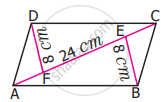
Ratio of area of ∆MNO to the area of parallelogram MNOP in the same figure is ______.
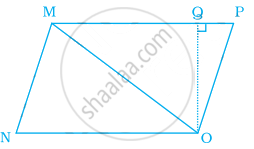
If perimeter of two parallelograms are equal, then their areas are also equal.
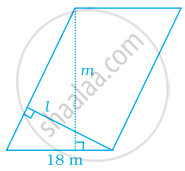
Perimeter of a parallelogram shaped land is 96 m and its area is 270 square metres. If one of the sides of this parallelogram is 18 m, find the length of the other side. Also, find the lengths of altitudes l and m (see figure).