Advertisements
Advertisements
प्रश्न
Find the missing values.
| Base | Height | Area |
| 8 cm | 56 sq.m |
Advertisements
उत्तर
Base b = 8 m
Area of the parallelogram = 56 sq.m
b × h = 56
8 × A = 56
h = `56/8`
h = 7 m
Tabulating the results, we get
| Base | Height | Area |
| 8 cm | 7 m | 56 sq.m |
APPEARS IN
संबंधित प्रश्न
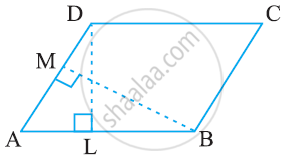
DL and BM are the heights on sides AB and AD respectively of parallelogram ABCD (see the given figure). If the area of the parallelogram is 1470 cm2, AB = 35 cm and AD = 49 cm, find the length of BM and DL.
Area of a parallelogram is 83.2 sq cm. If its height is 6.4 cm, find the length of its base.
A ground is in the shape of parallelogram. The height of the parallelogram is 14 metres and the corresponding base is 8 metres longer than its height. Find the cost of levelling the ground at the rate of ₹ 15 per sq.m
The area of parallelogram whose base 10 m and height 7 m is
A square and a parallelogram have the same area. If the side of the square is 48 m and the height of the parallelogram is 18 m. Find the length of the base of the parallelogram
Find the missing value:
| Base | Height | Area of parallelogram |
| 15.6 cm | ______ | 16.38 cm2 |
To find area, any side of a parallelogram can be chosen as ______ of the parallelogram.
All parallelograms having equal areas have same perimeters.
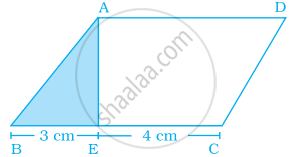
In the following figure, find the area of parallelogram ABCD if the area of shaded triangle is 9 cm2.
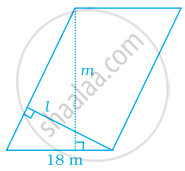
Perimeter of a parallelogram shaped land is 96 m and its area is 270 square metres. If one of the sides of this parallelogram is 18 m, find the length of the other side. Also, find the lengths of altitudes l and m (see figure).