Advertisements
Advertisements
प्रश्न
Area of a parallelogram is 83.2 sq cm. If its height is 6.4 cm, find the length of its base.
Advertisements
उत्तर
Area of a parallelogram = 83.2 sq.cm.
Height = 6.4 cm, Base = ?
We know that,
Area of a parallelogram = Base × height
83.2 = Base × 6.4
`(83.2 xx 10)/(6.4 xx 10)` = Base
Base = `832/64`
Base = `104/8`
∴ Base = 13 cm
Hence, Base of a parallelogram is 13 cm.
संबंधित प्रश्न
If base of a parallelogram is 18 cm and its height is 11 cm, find its area.
A parallelogram has sides of 15 cm and 12 cm; if the distance between the 15 cm sides is 6 cm; find the distance between 12 cm sides.
The adjacent sides of a parallelogram are 21 cm and 28 cm. If it's one diagonal is 35 cm; find the area of the parallelogram.
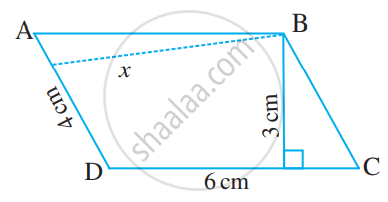
The two sides of the parallelogram ABCD are 6 cm and 4 cm. The height corresponding to the base CD is 3 cm.
Find the
(i) area of the parallelogram.
(ii) the height corresponding to the base AD.
Suresh on a parallelogram-shaped trophy in a state level chess tournament. He knows that the area of the trophy is 735 sq.cm and its base is 21 cm. What is the height of that trophy?
The area of the parallelogram ABCD is 1470 sq.cm. If AB = 49 cm and AD = 35 cm then, find the height, DF and BE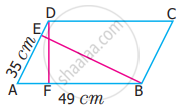
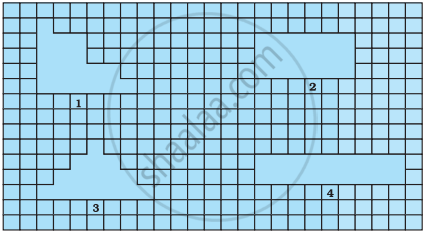
Observe the shapes 1, 2, 3 and 4 in the figures. Which of the following statements is not correct?
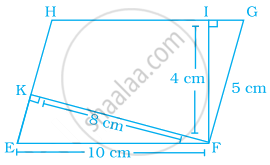
In the following figure, EFGH is a parallelogram, altitudes FK and FI are 8 cm and 4 cm respectively. If EF = 10 cm, then area of EFGH is ______.
All parallelograms having equal areas have same perimeters.
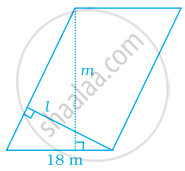
Perimeter of a parallelogram shaped land is 96 m and its area is 270 square metres. If one of the sides of this parallelogram is 18 m, find the length of the other side. Also, find the lengths of altitudes l and m (see figure).