Advertisements
Advertisements
प्रश्न
Area of a parallelogram is 83.2 sq cm. If its height is 6.4 cm, find the length of its base.
Advertisements
उत्तर
Area of a parallelogram = 83.2 sq.cm.
Height = 6.4 cm, Base = ?
We know that,
Area of a parallelogram = Base × height
83.2 = Base × 6.4
`(83.2 xx 10)/(6.4 xx 10)` = Base
Base = `832/64`
Base = `104/8`
∴ Base = 13 cm
Hence, Base of a parallelogram is 13 cm.
संबंधित प्रश्न
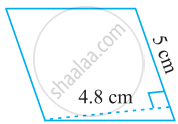
Find the area of the following parallelogram:
If base of a parallelogram is 18 cm and its height is 11 cm, find its area.
The adjacent sides of a parallelogram are 21 cm and 28 cm. If it's one diagonal is 35 cm; find the area of the parallelogram.
Find the height ‘x’ if the area of the parallelogram is 24 cm2 and the base is 4 cm.
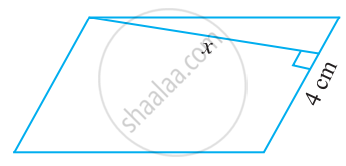
Find the missing values.
| Base | Height | Area |
| 8 cm | 56 sq.m |
What happens to the area of the parallelogram if the base is increased 2 times and the height is halved?
A square and a parallelogram have the same area. If the side of the square is 48 m and the height of the parallelogram is 18 m. Find the length of the base of the parallelogram
The height of the parallelogram is one-fourth of its base. If the area of the parallelogram is 676 sq.cm, find the height and the base
If the base and height of a parallelogram are in the ratio 7 : 3 and the height is 45 cm, then fixed the area of the parallelogram
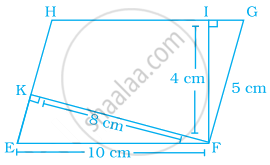
In the following figure, EFGH is a parallelogram, altitudes FK and FI are 8 cm and 4 cm respectively. If EF = 10 cm, then area of EFGH is ______.