Advertisements
Advertisements
प्रश्न
A square and a parallelogram have the same area. If the side of the square is 48 m and the height of the parallelogram is 18 m. Find the length of the base of the parallelogram
Advertisements
उत्तर
Given side of the square is 48 m
Area of the square = (side × side) sq.unit
= 48 × 48 m2
Height of the parallelogram = 18 m
Area of the parallelogram = ‘bh’ sq.units
= b × 18 m2
Also area of the parallelogram = Area of the square
b × 18 = 48 × 48
b = `(48 xx 48)/18`
= 8 × 16
= 128 m
Base of the parallelogram = 128 m
APPEARS IN
संबंधित प्रश्न
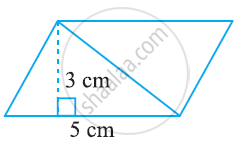
Find the area of the following parallelogram:
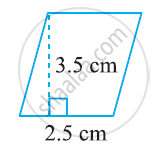
Find the area of the following parallelogram:
If area of a parallelogram is 29.6 sq cm and its base is 8 cm, find its height.
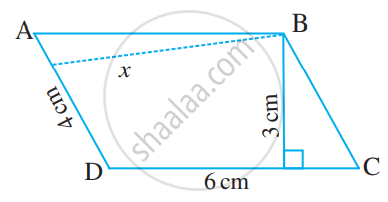
The two sides of the parallelogram ABCD are 6 cm and 4 cm. The height corresponding to the base CD is 3 cm.
Find the
(i) area of the parallelogram.
(ii) the height corresponding to the base AD.
The area of parallelogram whose base 10 m and height 7 m is
If the base and height of a parallelogram are in the ratio 7 : 3 and the height is 45 cm, then fixed the area of the parallelogram
Find the area of the parallelogram ABCD if AC is 24 cm and BE = DF = 8 cm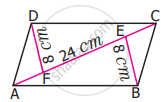
Find the missing value:
| Base | Height | Area of parallelogram |
| 15.6 cm | ______ | 16.38 cm2 |
If perimeter of two parallelograms are equal, then their areas are also equal.
All parallelograms having equal areas have same perimeters.
