Advertisements
Advertisements
प्रश्न
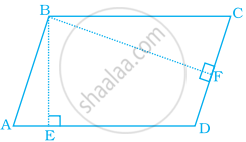
The area of the parallelogram ABCD is 1470 sq.cm. If AB = 49 cm and AD = 35 cm then, find the height, DF and BE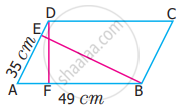
Advertisements
उत्तर
Area of the parallelogram = 1470 sq.cm
Considering AB = base = 49 cm
Height = DF
Area = base × height
49 × DF = 1470
DF = `1470/49`
DF = 30 cm
Now considering AD as base
Base = AD = 35 cm, height = BE
Base × Height = 1470
35 × BE = 1470, BE = `1470/35`
BE = 42 cm, DF = 30 cm, BE = 42 cm
APPEARS IN
संबंधित प्रश्न
Find the area of the following parallelogram:
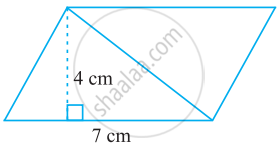
Find the area of the following parallelogram:
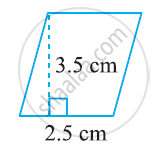
Find the missing value:
| Base | Height | Area of parallelogram |
| 20 cm | ______ | 246 cm2 |
If base of a parallelogram is 18 cm and its height is 11 cm, find its area.
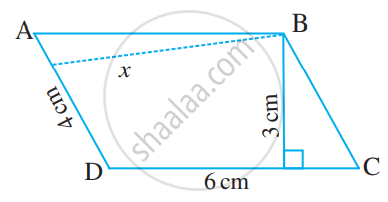
The two sides of the parallelogram ABCD are 6 cm and 4 cm. The height corresponding to the base CD is 3 cm.
Find the
(i) area of the parallelogram.
(ii) the height corresponding to the base AD.
The area of parallelogram whose base 10 m and height 7 m is
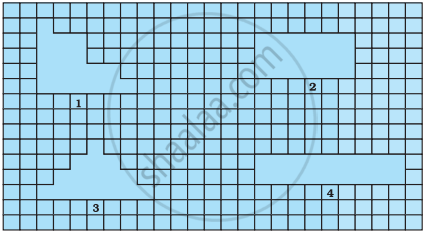
Observe the shapes 1, 2, 3 and 4 in the figures. Which of the following statements is not correct?
Area of parallelogram ABCD (see the figure) is not equal to ______.
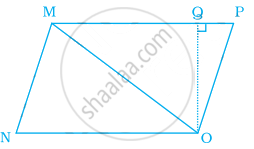
Ratio of area of ∆MNO to the area of parallelogram MNOP in the same figure is ______.
If the sides of a parallelogram are increased to twice its original lengths, how much will the perimeter of the new parallelogram?
