Advertisements
Advertisements
Question
The area of the parallelogram ABCD is 1470 sq.cm. If AB = 49 cm and AD = 35 cm then, find the height, DF and BE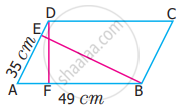
Advertisements
Solution
Area of the parallelogram = 1470 sq.cm
Considering AB = base = 49 cm
Height = DF
Area = base × height
49 × DF = 1470
DF = `1470/49`
DF = 30 cm
Now considering AD as base
Base = AD = 35 cm, height = BE
Base × Height = 1470
35 × BE = 1470, BE = `1470/35`
BE = 42 cm, DF = 30 cm, BE = 42 cm
APPEARS IN
RELATED QUESTIONS
If base of a parallelogram is 18 cm and its height is 11 cm, find its area.
A parallelogram has sides of 20 cm and 30 cm. If the distance between its shorter sides is 15 cm; find the distance between the longer sides.
What happens to the area of the parallelogram if the base is increased 2 times and the height is halved?
In a parallelogram the base is three times its height. If the height is 8 cm then the area is
An agricultural field is in the form of a parallelogram, whose area is 68.75 sq.hm. The distance between the parallel sides is 6.25 cm. Find the length of the base
Find the area of the parallelogram ABCD if AC is 24 cm and BE = DF = 8 cm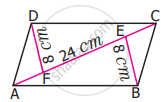
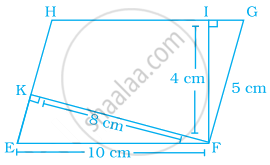
In the following figure, EFGH is a parallelogram, altitudes FK and FI are 8 cm and 4 cm respectively. If EF = 10 cm, then area of EFGH is ______.
If the sides of a parallelogram are increased to twice its original lengths, how much will the perimeter of the new parallelogram?
To find area, any side of a parallelogram can be chosen as ______ of the parallelogram.
ABCD is a parallelogram in which AE is perpendicular to CD (see figure). Also AC = 5 cm, DE = 4 cm and area of ΔAED = 6 cm2. Find the perimeter and area of ABCD.
