Advertisements
Advertisements
Question
To find area, any side of a parallelogram can be chosen as ______ of the parallelogram.
Advertisements
Solution
To find area, any side of a parallelogram can be chosen as base of the parallelogram.
Explanation:
While calculating the area of the parallelogram, we can choose any side as base.
APPEARS IN
RELATED QUESTIONS
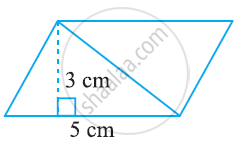
Find the area of the following parallelogram:
Find the missing value:
| Base | Height | Area of parallelogram |
| 20 cm | ______ | 246 cm2 |
The adjacent sides of a parallelogram are 21 cm and 28 cm. If it's one diagonal is 35 cm; find the area of the parallelogram.
Find the missing values.
| Base | Height | Area |
| 17 mm | 221 sq.mm |
Suresh on a parallelogram-shaped trophy in a state level chess tournament. He knows that the area of the trophy is 735 sq.cm and its base is 21 cm. What is the height of that trophy?
The base of the parallelogram with area is 52 sq.cm and height 4 cm is
If the base and height of a parallelogram are in the ratio 7 : 3 and the height is 45 cm, then fixed the area of the parallelogram
Perpendicular dropped on the base of a parallelogram from the opposite vertex is known as the corresponding ______ of the base.
If perimeter of two parallelograms are equal, then their areas are also equal.
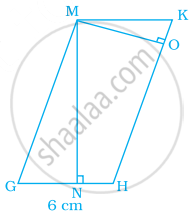
Altitudes MN and MO of parallelogram MGHK are 8 cm and 4 cm long respectively (see figure). One side GH is 6 cm long. Find the perimeter of MGHK.