Advertisements
Advertisements
Question
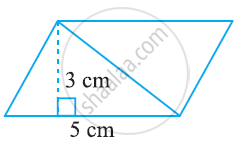
Find the area of the following parallelogram:
Advertisements
Solution
Area of parallelogram = Base × Height
Height = 3 cm
Base = 5 cm
Area of parallelogram = 5 × 3
= 15 cm2
RELATED QUESTIONS
If base of a parallelogram is 18 cm and its height is 11 cm, find its area.
A parallelogram has sides of 20 cm and 30 cm. If the distance between its shorter sides is 15 cm; find the distance between the longer sides.
Suresh on a parallelogram-shaped trophy in a state level chess tournament. He knows that the area of the trophy is 735 sq.cm and its base is 21 cm. What is the height of that trophy?
A ground is in the shape of parallelogram. The height of the parallelogram is 14 metres and the corresponding base is 8 metres longer than its height. Find the cost of levelling the ground at the rate of ₹ 15 per sq.m
Find the height of the parallelogram whose base is four times the height and whose area is 576 sq.cm
Find the missing value:
| Base | Height | Area of parallelogram |
| 15.6 cm | ______ | 16.38 cm2 |
In the following figure, area of parallelogram BCEF is ________ cm2 where ACDF is a rectangle.

Perpendicular dropped on the base of a parallelogram from the opposite vertex is known as the corresponding ______ of the base.
All parallelograms having equal areas have same perimeters.
ABCD is a parallelogram in which AE is perpendicular to CD (see figure). Also AC = 5 cm, DE = 4 cm and area of ΔAED = 6 cm2. Find the perimeter and area of ABCD.
