Advertisements
Advertisements
Question
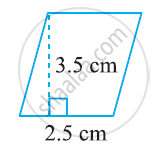
Find the area of the following parallelogram:
Advertisements
Solution
Area of parallelogram = Base × Height
Height = 3.5 cm
Base = 2.5 cm
Area of parallelogram = 2.5 × 3.5
= 8.75 cm2
RELATED QUESTIONS
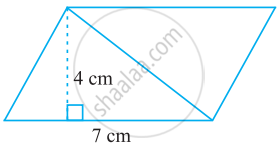
Find the area of the following parallelogram:
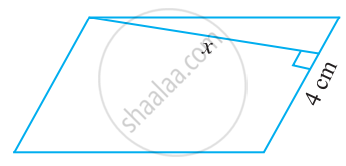
Find the height ‘x’ if the area of the parallelogram is 24 cm2 and the base is 4 cm.
The two sides of the parallelogram ABCD are 6 cm and 4 cm. The height corresponding to the base CD is 3 cm.
Find the
(i) area of the parallelogram.
(ii) the height corresponding to the base AD.
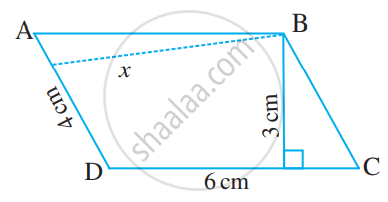
Find the missing values.
| Base | Height | Area |
| 18 cm | 5 cm |
Find the missing values.
| Base | Height | Area |
| 8 cm | 56 sq.m |
A ground is in the shape of parallelogram. The height of the parallelogram is 14 metres and the corresponding base is 8 metres longer than its height. Find the cost of levelling the ground at the rate of ₹ 15 per sq.m
The base of the parallelogram is 16 cm and the height is 7 cm less than its base. Find the area of the parallelogram
A square and a parallelogram have the same area. If the side of the square is 48 m and the height of the parallelogram is 18 m. Find the length of the base of the parallelogram
Find the area of the parallelogram ABCD if AC is 24 cm and BE = DF = 8 cm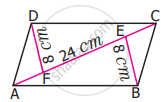
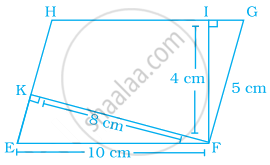
In the following figure, EFGH is a parallelogram, altitudes FK and FI are 8 cm and 4 cm respectively. If EF = 10 cm, then area of EFGH is ______.