Advertisements
Advertisements
Question
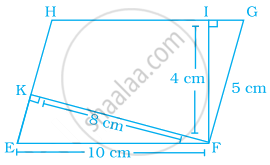
In the following figure, EFGH is a parallelogram, altitudes FK and FI are 8 cm and 4 cm respectively. If EF = 10 cm, then area of EFGH is ______.
Options
20 cm2
32 cm2
40 cm2
80 cm2
Advertisements
Solution
In the following figure, EFGH is a parallelogram, altitudes FK and FI are 8 cm and 4 cm respectively. If EF = 10 cm, then area of EFGH is `bb(underline(40 cm^2))`.
Explanation:
From the figure,
Consider the parallelogram EFGH,
EF = HG = 10 cm ...[From the question]
We know that,
Area of parallelogram EFGH = Base × Corresponding height
= 10 × 4
= 40 cm2
APPEARS IN
RELATED QUESTIONS
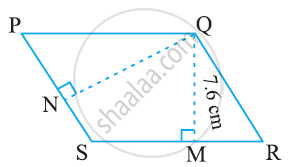
PQRS is a parallelogram (see the given figure). QM is the height from Q to SR and QN is the height from Q to PS. If SR = 12 cm and QM = 7.6 cm. Find:
- the area of the parallelogram PQRS
- QN, if PS = 8 cm
A parallelogram has sides of 20 cm and 30 cm. If the distance between its shorter sides is 15 cm; find the distance between the longer sides.
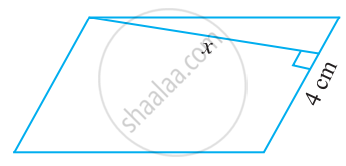
Find the height ‘x’ if the area of the parallelogram is 24 cm2 and the base is 4 cm.
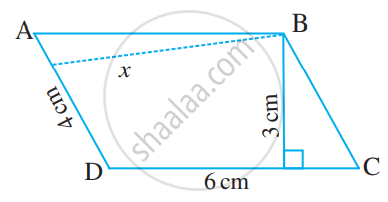
The two sides of the parallelogram ABCD are 6 cm and 4 cm. The height corresponding to the base CD is 3 cm.
Find the
(i) area of the parallelogram.
(ii) the height corresponding to the base AD.
Find the missing values.
| Base | Height | Area |
| 8 cm | 56 sq.m |
The base of the parallelogram with area is 52 sq.cm and height 4 cm is
The base of the parallelogram is 16 cm and the height is 7 cm less than its base. Find the area of the parallelogram
A square and a parallelogram have the same area. If the side of the square is 48 m and the height of the parallelogram is 18 m. Find the length of the base of the parallelogram
Find the area of the parallelogram ABCD if AC is 24 cm and BE = DF = 8 cm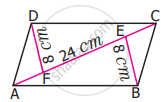
Perpendicular dropped on the base of a parallelogram from the opposite vertex is known as the corresponding ______ of the base.
