Advertisements
Advertisements
Question
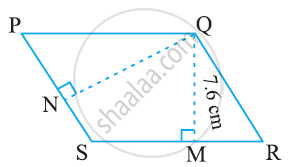
PQRS is a parallelogram (see the given figure). QM is the height from Q to SR and QN is the height from Q to PS. If SR = 12 cm and QM = 7.6 cm. Find:
- the area of the parallelogram PQRS
- QN, if PS = 8 cm
Advertisements
Solution
a. Area of parallelogram = Base × Height
= SR × QM
= 7.6 × 12
= 91.2 cm2
b. Area of parallelogram = Base × Height
91.2 cm2 = PS × QN
QN × 8 = 91.2
QN = `91.2/8`
QN = 11.4 cm
RELATED QUESTIONS
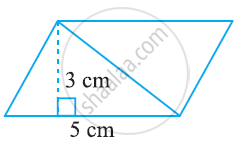
Find the area of the following parallelogram:
A parallelogram has sides of 15 cm and 12 cm; if the distance between the 15 cm sides is 6 cm; find the distance between 12 cm sides.
Find the missing values.
| Base | Height | Area |
| 18 cm | 5 cm |
A square and a parallelogram have the same area. If the side of the square is 48 m and the height of the parallelogram is 18 m. Find the length of the base of the parallelogram
The height of the parallelogram is one-fourth of its base. If the area of the parallelogram is 676 sq.cm, find the height and the base
In a parallelogram PQRS (See the diagram) PM and PN are the heights corresponding to the sides QR and RS respectively. If the area of the parallelogram is 900 sq.cm and the length of PM and PN are 20 cm and 36 cm respectively, find the length of the sides QR and SR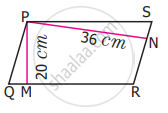
Find the missing value:
| Base | Height | Area of parallelogram |
| 15.6 cm | ______ | 16.38 cm2 |
Area of parallelogram ABCD (see the figure) is not equal to ______.
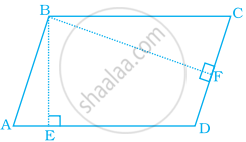
To find area, any side of a parallelogram can be chosen as ______ of the parallelogram.
In the following figure, area of ∆AFB is equal to the area of parallelogram ABCD. If altitude EF is 16 cm long, find the altitude of the parallelogram to the base AB of length 10 cm. What is the area of ∆DAO, where O is the midpoint of DC?

