Advertisements
Advertisements
Question
Find the missing value:
| Base | Height | Area of Triangle |
| 22 cm | ______ | 170.5 cm2 |
Advertisements
Solution
| Base | Height | Area of Triangle |
| 22 cm | 15.5 | 170.5 cm2 |
Explanation:
b = 22 cm
h = ?
Area = `1/2 xx b xx h` = 170.5 cm2
`1/2 xx 22 xx h` = 170.5 cm2
h = `(170.5 xx 2)/22`
h = 15.5 cm
Therefore, the height of such triangle is 15.5 cm.
RELATED QUESTIONS
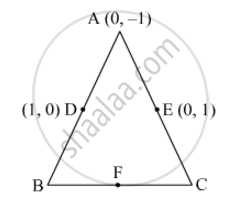
In Fig. 6, ABC is a triangle coordinates of whose vertex A are (0, −1). D and E respectively are the mid-points of the sides AB and AC and their coordinates are (1, 0) and (0, 1) respectively. If F is the mid-point of BC, find the areas of ∆ABC and ∆DEF.
Prove that the points (a, b + c), (b, c + a) and (c, a + b) are collinear
In each of the following find the value of 'k', for which the points are collinear.
(8, 1), (k, -4), (2, -5)
Find the area of ΔABC with A(1, –4) and midpoints of sides through A being (2, –1) and (0, –1).
Find the value of k so that the area of the triangle with vertices A(k + 1, 1), B(4, –3) and C(7, –k) is 6 square units.
Find the value of x for which the points A(x, 2), B(–3, –4) and C(7, –5) are collinear.
For what value of x are the points A(−3, 12), B(7, 6) and C(x, 9) collinear.
In the following figure, if PR = 12 cm, QR = 6 cm and PL = 8 cm, then QM is ______.

Triangles having the same base have equal area.
If (a, b), (c, d) and (e, f) are the vertices of ΔABC and Δ denotes the area of ΔABC, then `|(a, c, e),(b, d, f),(1, 1, 1)|^2` is equal to ______.
