Advertisements
Advertisements
Question
Ratio of areas of ∆MNO, ∆MOP and ∆MPQ in the following figure is ______.

Options
2 : 1 : 3
1 : 3 : 2
2 : 3 : 1
1 : 2 : 3
Advertisements
Solution
Ratio of areas of ∆MNO, ∆MOP and ∆MPQ in the following figure is 2 : 1 : 3.
Explanation:
We know that, area of triangle = `1/2` × base × height
So, area of triangle MNO = `1/2` × NO × MO
= `1/2` × 5 × 4
= `1/2` × 20
= 10 cm2
Area of triangle MOP = `1/2` × MO × OP
= `1/2` × 5 × 2
= `1/2` × 10
= 5 cm2
Area of triangle MPQ = `1/2` × MO × PQ ...[MP = MO]
= `1/2` × 5 × 6
= `1/2` × 30
= 15 cm2
So, the ratio of area = 10 : 5 : 15 ...[Divide each by 5]
Then we get, 2 : 1 : 3
APPEARS IN
RELATED QUESTIONS
Find the area of the triangle formed by joining the mid-point of the sides of the triangle whose vertices are (0, –1), (2, 1) and (0, 3). Find the ratio of area of the triangle formed to the area of the given triangle.
For what value of k are the points (k, 2 – 2k), (–k + 1, 2k) and (–4 – k, 6 – 2k) are collinear ?
Find the equation of the line joining (1, 2) and (3, 6) using the determinants.
Find the area of a triangle whose vertices are
(6,3), (-3,5) and (4,2)
Prove that the lines joining the middle points of the opposite sides of a quadrilateral and the join of the middle points of its diagonals meet in a point and bisect one another
Find the area of ΔABC with A(1, –4) and midpoints of sides through A being (2, –1) and (0, –1).
Find the values of k if the points A(k + 1, 2k), B(3k, 2k + 3) and C(5k – 1, 5k) are collinear.
A rectangular plot is given for constructing a house, having a measurement of 40 m long and 15 m in the front. According to the laws, a minimum of 3 m, wide space should be left in the front and back each and 2 m wide space on each of other sides. Find the largest area where house can be constructed.
Find the missing value:
| Base | Height | Area of parallelogram |
| ______ | 15 cm | 154.5 cm2 |
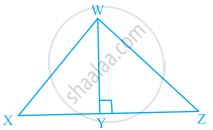
Ratio of the area of ∆WXY to the area of ∆WZY is 3 : 4 (see figure). If the area of ∆WXZ is 56 cm2 and WY = 8 cm, find the lengths of XY and YZ.