Advertisements
Advertisements
प्रश्न
Ratio of areas of ∆MNO, ∆MOP and ∆MPQ in the following figure is ______.

पर्याय
2 : 1 : 3
1 : 3 : 2
2 : 3 : 1
1 : 2 : 3
Advertisements
उत्तर
Ratio of areas of ∆MNO, ∆MOP and ∆MPQ in the following figure is 2 : 1 : 3.
Explanation:
We know that, area of triangle = `1/2` × base × height
So, area of triangle MNO = `1/2` × NO × MO
= `1/2` × 5 × 4
= `1/2` × 20
= 10 cm2
Area of triangle MOP = `1/2` × MO × OP
= `1/2` × 5 × 2
= `1/2` × 10
= 5 cm2
Area of triangle MPQ = `1/2` × MO × PQ ...[MP = MO]
= `1/2` × 5 × 6
= `1/2` × 30
= 15 cm2
So, the ratio of area = 10 : 5 : 15 ...[Divide each by 5]
Then we get, 2 : 1 : 3
APPEARS IN
संबंधित प्रश्न
Find the values of k so that the area of the triangle with vertices (k + 1, 1), (4, -3) and (7, -k) is 6 sq. units.
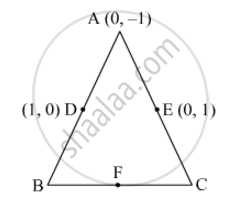
In Fig. 6, ABC is a triangle coordinates of whose vertex A are (0, −1). D and E respectively are the mid-points of the sides AB and AC and their coordinates are (1, 0) and (0, 1) respectively. If F is the mid-point of BC, find the areas of ∆ABC and ∆DEF.
Find the area of the triangle formed by joining the mid-point of the sides of the triangle whose vertices are (0, –1), (2, 1) and (0, 3). Find the ratio of area of the triangle formed to the area of the given triangle.
Find the area of the triangle whose vertices are: (2, 3), (-1, 0), (2, -4)
Find the area of a triangle with vertices at the point given in the following:
(1, 0), (6, 0), (4, 3)
Find the area of a triangle with vertices at the point given in the following:
(−2, −3), (3, 2), (−1, −8)
Find the missing value:
| Base | Height | Area of triangle |
| 15 cm | ______ | 87 cm2 |
Find the area of the quadrilaterals, the coordinates of whose vertices are (–3, 2), (5, 4), (7, –6) and (–5, –4).
Find the third vertex of a ΔABC if two of its vertices are B(–3, 1) and C(0, –2) and its centroid is at the origin.
If area of a triangular piece of cardboard is 90 cm2, then the length of altitude corresponding to 20 cm long base is ______ cm.
