Advertisements
Advertisements
प्रश्न
If area of a triangular piece of cardboard is 90 cm2, then the length of altitude corresponding to 20 cm long base is ______ cm.
Advertisements
उत्तर
If area of a triangular piece of cardboard is 90 cm2, then the length of altitude corresponding to 20 cm long base is 9 cm.
Explanation:
We know that,
Area of triangle = `1/2` × base × height
90 = `1/2` × 20 × height
Height = 9 cm
APPEARS IN
संबंधित प्रश्न
Find the area of a triangle with vertices at the point given in the following:
(1, 0), (6, 0), (4, 3)
Find values of k if area of triangle is 4 sq. units and vertices are (k, 0), (4, 0), (0, 2).
Find the centroid of the triangle whose vertices is (1, 4), (–1, –1) and (3, –2).
Show that the points O(0, 0), `A(3, sqrt(3))` and `B(3, -sqrt(3))` are the vertices of an equilateral triangle. Find the area of this triangle.
If the points A (x, y), B (3, 6) and C (−3, 4) are collinear, show that x − 3y + 15 = 0.
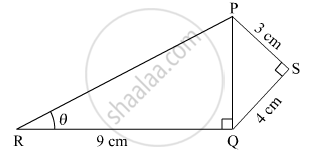
In Figure 1, PS = 3 cm, QS = 4 cm, ∠PRQ = θ, ∠PSQ = 90°, PQ ⊥ RQ and RQ = 9 cm. Evaluate tan θ.
Using integration, find the area of triangle ABC, whose vertices are A(2, 5), B(4, 7) and C(6, 2).
Find the value of m if the points (5, 1), (–2, –3) and (8, 2m) are collinear.
Find the missing value:
| Base | Height | Area of Triangle |
| ______ | 31.4 mm | 1256 mm2 |
Find the missing value:
| Base | Height | Area of Triangle |
| 22 cm | ______ | 170.5 cm2 |
