Advertisements
Advertisements
प्रश्न
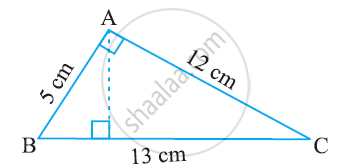
ΔABC is right angled at A (see the given figure). AD is perpendicular to BC. If AB = 5 cm, BC = 13 cm and AC = 12 cm, Find the area of ΔABC. Also find the length of AD.
Advertisements
उत्तर
Area = `1/2 xx "Base" xx "Height"`
Area of ΔABC = `1/2 xx "AB" xx "AC"`
= `1/2 xx 5 xx 12`
= 30 cm2
Also, area of triangle = `1/2 xx "AD" xx "BC"`
30 = `1/2 xx "AD" xx 13`
`(30 xx 2)/13` = AD
AD = 4.6 cm
संबंधित प्रश्न
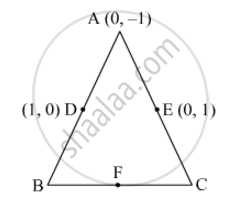
In Fig. 6, ABC is a triangle coordinates of whose vertex A are (0, −1). D and E respectively are the mid-points of the sides AB and AC and their coordinates are (1, 0) and (0, 1) respectively. If F is the mid-point of BC, find the areas of ∆ABC and ∆DEF.
Find the area of the quadrilateral ABCD whose vertices are respectively A(1, 1), B(7, –3), C(12, 2) and D(7, 21).
In each of the following find the value of 'k', for which the points are collinear.
(7, -2), (5, 1), (3, -k)
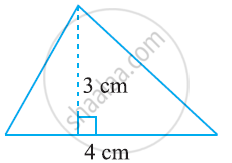
Find the area of the following triangle:
Find the area of the quadrilaterals, the coordinates of whose vertices are (–3, 2), (5, 4), (7, –6) and (–5, –4).
Find the value of k so that the area of the triangle with vertices A(k + 1, 1), B(4, –3) and C(7, –k) is 6 square units.
Show that ∆ ABC with vertices A (–2, 0), B (0, 2) and C (2, 0) is similar to ∆ DEF with vertices D (–4, 0), F (4, 0) and E (0, 4) ?
The area of a triangle with vertices (–3, 0), (3, 0) and (0, k) is 9 sq.units. The value of k will be ______.
Area of a triangle = `1/2` base × ______.
In the following figure, area of ΔPQR is 20 cm2 and area of ΔPQS is 44 cm2. Find the length RS, if PQ is perpendicular to QS and QR is 5 cm.

