Advertisements
Advertisements
प्रश्न
Find the area of the following triangle:

Advertisements
उत्तर
Area of triangle = `1/2 xx "Base" xx "Height"`
Base = 5 cm,
Height = 3.2 cm
Area = `1/2 xx 5 xx 3.2`
= 8 cm2
संबंधित प्रश्न
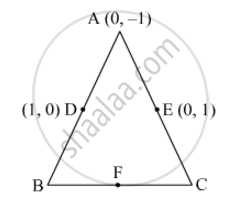
In Fig. 6, ABC is a triangle coordinates of whose vertex A are (0, −1). D and E respectively are the mid-points of the sides AB and AC and their coordinates are (1, 0) and (0, 1) respectively. If F is the mid-point of BC, find the areas of ∆ABC and ∆DEF.
If P(–5, –3), Q(–4, –6), R(2, –3) and S(1, 2) are the vertices of a quadrilateral PQRS, find its area.
Find values of k if area of triangle is 4 sq. units and vertices are (−2, 0), (0, 4), (0, k).
Prove that the points (2, 3), (-4, -6) and `(1, 3/2)` do not form a triangle.
Prove that the points A(7, 10), B(–2, 5) and C(3, –4) are the vertices of an isosceles right triangle.
Show that the points A(–5, 6), B(3, 0) and C(9, 8) are the vertices of an isosceles right-angled triangle. Calculate its area.
Show that the points A(3, 1), B(0, –2), C(1, 1) and D(4, 4) are the vertices of a parallelogram ABCD.
Find the value(s) of k so that the quadratic equation x2 − 4kx + k = 0 has equal roots.
The points (1,1), (-2, 7) and (3, -3) are ______.
Area of a right-angled triangle is 30 cm2. If its smallest side is 5 cm, then its hypotenuse is ______.
