Advertisements
Advertisements
प्रश्न
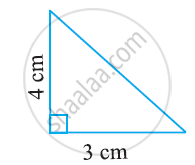
Find the area of the following triangle:
Advertisements
उत्तर
Area of triangle = `1/2 xx "Base" xx "Height"`
Base = 3 cm,
Height = 4 cm
Area = `1/2 xx 3 xx 4`
= 6 cm2
संबंधित प्रश्न
Find the area of the triangle whose vertices are: (–5, –1), (3, –5), (5, 2)
In each of the following find the value of 'k', for which the points are collinear.
(8, 1), (k, -4), (2, -5)
Find the area of the quadrilateral whose vertices, taken in order, are (–4, –2), (–3, –5), (3, –2) and (2, 3).
Find the equation of the line joining (3, 1) and (9, 3) using the determinants.
Show that the following sets of points are collinear.
(2, 5), (4, 6) and (8, 8)
Find the centroid of the triangle whose vertices is (1, 4), (–1, –1) and (3, –2).
Prove that the lines joining the middle points of the opposite sides of a quadrilateral and the join of the middle points of its diagonals meet in a point and bisect one another
Find the area of ΔABC with A(1, –4) and midpoints of sides through A being (2, –1) and (0, –1).
If area of a triangular piece of cardboard is 90 cm2, then the length of altitude corresponding to 20 cm long base is ______ cm.
Area of a triangle = `1/2` base × ______.
