Advertisements
Advertisements
Question
Find the area of the following triangle:

Advertisements
Solution
Area of triangle = `1/2 xx "Base" xx "Height"`
Base = 5 cm,
Height = 3.2 cm
Area = `1/2 xx 5 xx 3.2`
= 8 cm2
RELATED QUESTIONS
Find the values of k for which the points A(k + 1, 2k), B(3k, 2k + 3) and (5k – 1, 5k) are collinear.
The perimeter of a right triangle is 60 cm. Its hypotenuse is 25 cm. Find the area of the triangle.
Find the area of the triangle whose vertices are: (2, 3), (-1, 0), (2, -4)
Find values of k if area of triangle is 4 sq. units and vertices are (−2, 0), (0, 4), (0, k).
Show that the following points are collinear:
A(5, 1), B(1, –1) and C(11, 4)
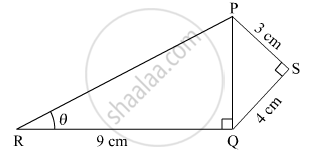
In Figure 1, PS = 3 cm, QS = 4 cm, ∠PRQ = θ, ∠PSQ = 90°, PQ ⊥ RQ and RQ = 9 cm. Evaluate tan θ.
A field is in the shape of a right angled triangle whose base is 25 m and height 20 m. Find the cost of levelling the field at the rate of ₹ 45 per sq.m2
If the co-ordinates of the vertices of an equilateral triangle with sides of length ‘a’ are (x1, y1), (x2, y2), (x3, y3), then `|(x_1, y_1, 1),(x_2, y_2, 1),(x_3, y_3, 1)|^2 = (3"a"^4)/4`
Let `Delta = abs (("x", "y", "z"),("x"^2, "y"^2, "z"^2),("x"^3, "y"^3, "z"^3)),` then the value of `Delta` is ____________.
If area of a triangular piece of cardboard is 90 cm2, then the length of altitude corresponding to 20 cm long base is ______ cm.
