Advertisements
Advertisements
प्रश्न
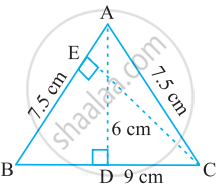
ΔABC is isosceles with AB = AC = 7.5 cm and BC = 9 cm (see the given figure). The height AD from A to BC, is 6 cm. Find the area of ΔABC. What will be the height from C to AB i.e., CE?
Advertisements
उत्तर
Area of triangle ABC = `1/2 xx "Base" xx "Height"`
= `1/2 xx BC xx AD`
= `1/2 xx 9 xx 6`
= 27 cm2
Area of triangle ABC = `1/2 xx "Base" xx "Height"`
= `1/2 xx AB xx CE`
`27 = 1/2 xx 7.5 xx CE`
CE = `(27 xx 2)/7.5`
CE = 7.2 cm
संबंधित प्रश्न
Prove that the points (a, b + c), (b, c + a) and (c, a + b) are collinear
If the coordinates of two points A and B are (3, 4) and (5, – 2) respectively. Find the coordniates of any point P, if PA = PB and Area of ∆PAB = 10
The vertices of a ΔABC are A (4, 6), B (1, 5) and C (7, 2). A line is drawn to intersect sides AB and AC at D and E respectively, such that `(AD)/(AB) = (AE)/(AC) = 1/4`Calculate the area of the ΔADE and compare it with the area of ΔABC. (Recall Converse of basic proportionality theorem and Theorem 6.6 related to ratio of areas of two similar triangles)
The area of a triangle is 5 sq units. Two of its vertices are (2, 1) and (3, –2). If the third vertex is `(7/2, y)`, find the value of y.
Prove that the lines joining the middle points of the opposite sides of a quadrilateral and the join of the middle points of its diagonals meet in a point and bisect one another
What is the area of a triangle with base 4.8 cm and height 3.6 cm?
If A, B, C are the angles of a triangle, then ∆ = `|(sin^2"A", cot"A", 1),(sin^2"B", cot"B", 1),(sin^2"C", cot"C", 1)|` = ______.
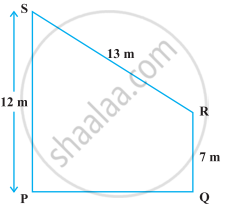
Find the area of the trapezium PQRS with height PQ given in the following figure.
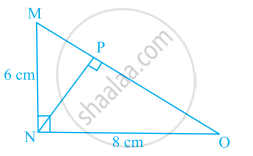
In the following figure, ΔMNO is a right-angled triangle. Its legs are 6 cm and 8 cm long. Length of perpendicular NP on the side MO is ______.
Find the missing value:
| Base | Height | Area of Triangle |
| ______ | 31.4 mm | 1256 mm2 |
