Advertisements
Advertisements
Question
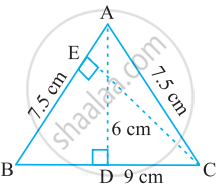
ΔABC is isosceles with AB = AC = 7.5 cm and BC = 9 cm (see the given figure). The height AD from A to BC, is 6 cm. Find the area of ΔABC. What will be the height from C to AB i.e., CE?
Advertisements
Solution
Area of triangle ABC = `1/2 xx "Base" xx "Height"`
= `1/2 xx BC xx AD`
= `1/2 xx 9 xx 6`
= 27 cm2
Area of triangle ABC = `1/2 xx "Base" xx "Height"`
= `1/2 xx AB xx CE`
`27 = 1/2 xx 7.5 xx CE`
CE = `(27 xx 2)/7.5`
CE = 7.2 cm
RELATED QUESTIONS
The point A divides the join of P (–5, 1) and Q (3, 5) in the ratio k : 1. Find the two values of k for which the area of ΔABC where B is (1, 5) and C (7, –2) is equal to 2 units.
Find the area of a triangle whose sides are respectively 150 cm, 120 cm and 200 cm ?
Show that ∆ ABC with vertices A (–2, 0), B (0, 2) and C (2, 0) is similar to ∆ DEF with vertices D (–4, 0), F (4, 0) and E (0, 4) ?
What is the area of a triangle with base 4.8 cm and height 3.6 cm?
Find the area of the following triangle:

If the sides of a triangle are 3 cm, 4 cm and 5 cm, then the area is
Find the coordinates of the point Q on the x-axis which lies on the perpendicular bisector of the line segment joining the points A(–5, –2) and B(4, –2). Name the type of triangle formed by the points Q, A and B.
A rectangular plot is given for constructing a house, having a measurement of 40 m long and 15 m in the front. According to the laws, a minimum of 3 m, wide space should be left in the front and back each and 2 m wide space on each of other sides. Find the largest area where house can be constructed.
Triangles having the same base have equal area.
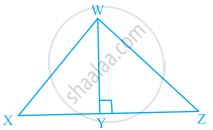
Ratio of the area of ∆WXY to the area of ∆WZY is 3 : 4 (see figure). If the area of ∆WXZ is 56 cm2 and WY = 8 cm, find the lengths of XY and YZ.