Advertisements
Advertisements
प्रश्न
In the following figure, triangle AEC is right-angled at E, B is a point on EC, BD is the altitude of triangle ABC, AC = 25 cm, BC = 7 cm and AE = 15 cm. Find the area of triangle ABC and the length of DB.

Advertisements
उत्तर
Given, AC = 25 cm, BC = 7 cm, and AE = 15 cm
In ΔAEC, using Pythagoras theorem,
AC2 = AE2 + EC2
⇒ EC2 = AC2 – AE2
⇒ EC2 = (25)2 – (15)2 = 625 – 225 = 400
EC = `sqrt(400)` = 20 cm
And EB = EC – BC = 20 – 7 = 13 cm
Area of ΔAEC = `1/2` × AE × EC
= `1/2 xx 15 xx 20`
= 150 cm2
And Area of ΔAEB = `1/2` × AE × EB
= `1/2 xx 15 xx 13`
= 97.5 cm2
∴ Area of ΔABC = Area of ΔAEC – Area of ΔAEB
= 150 – 97.5
= 52.5 cm2
Again, Area of ΔABC = `1/2` × BD × AC
52.5 = `1/2` × BD × 25
⇒ BD = `(52.5 xx 2)/25` = 4.2 cm
Hence, the area of ΔABC is 52.5 cm2 and the length of DB is 4.2 cm.
APPEARS IN
संबंधित प्रश्न
If the coordinates of two points A and B are (3, 4) and (5, – 2) respectively. Find the coordniates of any point P, if PA = PB and Area of ∆PAB = 10
Find the equation of the line joining (1, 2) and (3, 6) using the determinants.
Find the area of the following triangle:
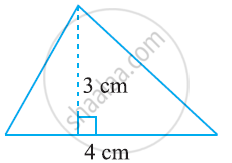
Find the area of triangle whose vertices are `(at_1^2, 2at_1), (at_2^2, 2at_2)` and `(at_3^2, 2at_3)`.
If the points P(–3, 9), Q(a, b) and R(4, –5) are collinear and a + b = 1, find the values of a and b.
Show that ∆ ABC with vertices A (–2, 0), B (0, 2) and C (2, 0) is similar to ∆ DEF with vertices D (–4, 0), F (4, 0) and E (0, 4) ?
Let ∆ = `|("A"x, x^2, 1),("B"y, y^2, 1),("C"z, z^2, 1)|`and ∆1 = `|("A", "B", "C"),(x, y, z),(zy, zx, xy)|`, then ______.
If the co-ordinates of the vertices of an equilateral triangle with sides of length ‘a’ are (x1, y1), (x2, y2), (x3, y3), then `|(x_1, y_1, 1),(x_2, y_2, 1),(x_3, y_3, 1)|^2 = (3"a"^4)/4`
If the points (2, -3), (k, -1), and (0, 4) are collinear, then find the value of 4k.
The points A(2, 9), B(a, 5) and C(5, 5) are the vertices of a triangle ABC right angled at B. Find the values of a and hence the area of ∆ABC.
