Advertisements
Advertisements
प्रश्न
In the following figure, triangle AEC is right-angled at E, B is a point on EC, BD is the altitude of triangle ABC, AC = 25 cm, BC = 7 cm and AE = 15 cm. Find the area of triangle ABC and the length of DB.

Advertisements
उत्तर
Given, AC = 25 cm, BC = 7 cm, and AE = 15 cm
In ΔAEC, using Pythagoras theorem,
AC2 = AE2 + EC2
⇒ EC2 = AC2 – AE2
⇒ EC2 = (25)2 – (15)2 = 625 – 225 = 400
EC = `sqrt(400)` = 20 cm
And EB = EC – BC = 20 – 7 = 13 cm
Area of ΔAEC = `1/2` × AE × EC
= `1/2 xx 15 xx 20`
= 150 cm2
And Area of ΔAEB = `1/2` × AE × EB
= `1/2 xx 15 xx 13`
= 97.5 cm2
∴ Area of ΔABC = Area of ΔAEC – Area of ΔAEB
= 150 – 97.5
= 52.5 cm2
Again, Area of ΔABC = `1/2` × BD × AC
52.5 = `1/2` × BD × 25
⇒ BD = `(52.5 xx 2)/25` = 4.2 cm
Hence, the area of ΔABC is 52.5 cm2 and the length of DB is 4.2 cm.
APPEARS IN
संबंधित प्रश्न
Find the area of the quadrilateral ABCD whose vertices are respectively A(1, 1), B(7, –3), C(12, 2) and D(7, 21).
The area of a triangle is 5 sq units. Two of its vertices are (2, 1) and (3, –2). If the third vertex is `(7/2, y)`, find the value of y.
Find the area of the following triangle:
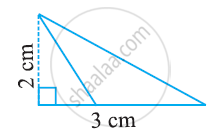
Find the area of the quadrilaterals, the coordinates of whose vertices are (–3, 2), (5, 4), (7, –6) and (–5, –4).
The area of a triangle is 5. Two of its vertices are (2, 1) and (3, –2). The third vertex lies on y = x + 3. Find the third vertex.
For what value of a the point (a, 1), (1, –1) and (11, 4) are collinear?
Show that the points A(3, 0), B(6, 4) and C(–1, 3) are the vertices of an isosceles right triangle.
What is the area of a triangle with base 4.8 cm and height 3.6 cm?
The area of a triangle with base 4 cm and height 6 cm is 24 cm2.
The area of a trapezium is 475 cm2 and the height is 19 cm. Find the lengths of its two parallel sides if one side is 4 cm greater than the other.
