Advertisements
Advertisements
प्रश्न
Ratio of areas of ∆MNO, ∆MOP and ∆MPQ in the following figure is ______.

विकल्प
2 : 1 : 3
1 : 3 : 2
2 : 3 : 1
1 : 2 : 3
Advertisements
उत्तर
Ratio of areas of ∆MNO, ∆MOP and ∆MPQ in the following figure is 2 : 1 : 3.
Explanation:
We know that, area of triangle = `1/2` × base × height
So, area of triangle MNO = `1/2` × NO × MO
= `1/2` × 5 × 4
= `1/2` × 20
= 10 cm2
Area of triangle MOP = `1/2` × MO × OP
= `1/2` × 5 × 2
= `1/2` × 10
= 5 cm2
Area of triangle MPQ = `1/2` × MO × PQ ...[MP = MO]
= `1/2` × 5 × 6
= `1/2` × 30
= 15 cm2
So, the ratio of area = 10 : 5 : 15 ...[Divide each by 5]
Then we get, 2 : 1 : 3
APPEARS IN
संबंधित प्रश्न
Find values of k if area of triangle is 4 sq. units and vertices are (−2, 0), (0, 4), (0, k).
Find the missing value:
| Base | Height | Area of triangle |
| 15 cm | ______ | 87 cm2 |
Show that the following sets of points are collinear.
(2, 5), (4, 6) and (8, 8)
Find the value(s) of k so that the quadratic equation x2 − 4kx + k = 0 has equal roots.
Using integration, find the area of triangle ABC, whose vertices are A(2, 5), B(4, 7) and C(6, 2).
If the points (a1, b1), (a2, b2) and(a1 + a2, b1 + b2) are collinear, then ____________.
Area of triangle PQR is 100 cm2 (see figure). If altitude QT is 10 cm, then its base PR is ______.

In the following figure, if PR = 12 cm, QR = 6 cm and PL = 8 cm, then QM is ______.

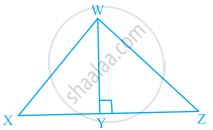
Ratio of the area of ∆WXY to the area of ∆WZY is 3 : 4 (see figure). If the area of ∆WXZ is 56 cm2 and WY = 8 cm, find the lengths of XY and YZ.
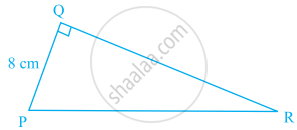
Area of a triangle PQR right-angled at Q is 60 cm2 (see figure). If the smallest side is 8 cm long, find the length of the other two sides.