Advertisements
Advertisements
प्रश्न
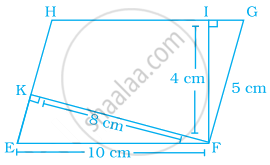
In the following figure, EFGH is a parallelogram, altitudes FK and FI are 8 cm and 4 cm respectively. If EF = 10 cm, then area of EFGH is ______.
विकल्प
20 cm2
32 cm2
40 cm2
80 cm2
Advertisements
उत्तर
In the following figure, EFGH is a parallelogram, altitudes FK and FI are 8 cm and 4 cm respectively. If EF = 10 cm, then area of EFGH is `bb(underline(40 cm^2))`.
Explanation:
From the figure,
Consider the parallelogram EFGH,
EF = HG = 10 cm ...[From the question]
We know that,
Area of parallelogram EFGH = Base × Corresponding height
= 10 × 4
= 40 cm2
APPEARS IN
संबंधित प्रश्न
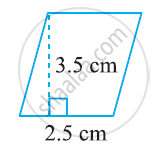
Find the area of the following parallelogram:
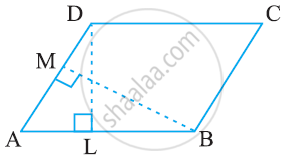
DL and BM are the heights on sides AB and AD respectively of parallelogram ABCD (see the given figure). If the area of the parallelogram is 1470 cm2, AB = 35 cm and AD = 49 cm, find the length of BM and DL.
If area of a parallelogram is 29.6 sq cm and its base is 8 cm, find its height.
A parallelogram has sides of 20 cm and 30 cm. If the distance between its shorter sides is 15 cm; find the distance between the longer sides.
The adjacent sides of a parallelogram are 21 cm and 28 cm. If it's one diagonal is 35 cm; find the area of the parallelogram.
In a parallelogram the base is three times its height. If the height is 8 cm then the area is
A square and a parallelogram have the same area. If the side of the square is 48 m and the height of the parallelogram is 18 m. Find the length of the base of the parallelogram
The area of the parallelogram ABCD is 1470 sq.cm. If AB = 49 cm and AD = 35 cm then, find the height, DF and BE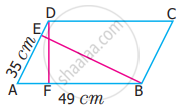
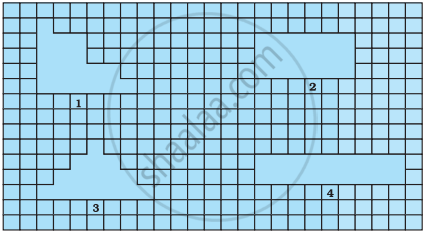
Observe the shapes 1, 2, 3 and 4 in the figures. Which of the following statements is not correct?
In the following figure, area of ∆AFB is equal to the area of parallelogram ABCD. If altitude EF is 16 cm long, find the altitude of the parallelogram to the base AB of length 10 cm. What is the area of ∆DAO, where O is the midpoint of DC?

