Advertisements
Advertisements
प्रश्न
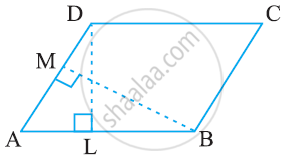
DL and BM are the heights on sides AB and AD respectively of parallelogram ABCD (see the given figure). If the area of the parallelogram is 1470 cm2, AB = 35 cm and AD = 49 cm, find the length of BM and DL.
Advertisements
उत्तर
Area of parallelogram = Base × Height
= AB × DL
1470 = 35 × DL
DL = `1470/35`
DL = 42 cm
Also, area of parallelogram = AD × BM
1470 = 49 × BM
∴ BM = `1470/49`
∴ BM = 30 cm
संबंधित प्रश्न
Find the area of the following parallelogram:
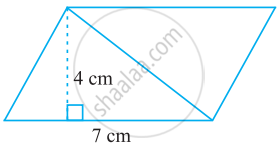
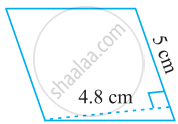
Find the area of the following parallelogram:
Find the missing value:
| Base | Height | Area of parallelogram |
| 20 cm | ______ | 246 cm2 |
Find the missing values.
| Base | Height | Area |
| 18 cm | 5 cm |
Suresh on a parallelogram-shaped trophy in a state level chess tournament. He knows that the area of the trophy is 735 sq.cm and its base is 21 cm. What is the height of that trophy?
The base of the parallelogram with area is 52 sq.cm and height 4 cm is
The base of the parallelogram is 16 cm and the height is 7 cm less than its base. Find the area of the parallelogram
A square and a parallelogram have the same area. If the side of the square is 48 m and the height of the parallelogram is 18 m. Find the length of the base of the parallelogram
Find the height of the parallelogram whose base is four times the height and whose area is 576 sq.cm
All parallelograms having equal areas have same perimeters.
