Advertisements
Advertisements
प्रश्न
Find the height of the parallelogram whose base is four times the height and whose area is 576 sq.cm
Advertisements
उत्तर
Let the height be ‘A’ and base be ‘h’ units
Given b = 4 × h
Area of the parallelogram = 576 sq.cm
b × h = 576
4h × h = 576
h × h = `576/4` = 144
h × h = 12 × 12
h = 12 cm
Height = 12 cm, base = 4 × 12 = 48 cm
APPEARS IN
संबंधित प्रश्न
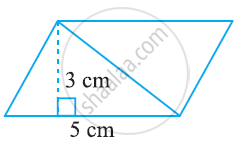
Find the area of the following parallelogram:
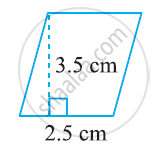
Find the area of the following parallelogram:
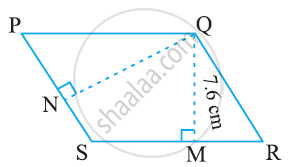
PQRS is a parallelogram (see the given figure). QM is the height from Q to SR and QN is the height from Q to PS. If SR = 12 cm and QM = 7.6 cm. Find:
- the area of the parallelogram PQRS
- QN, if PS = 8 cm
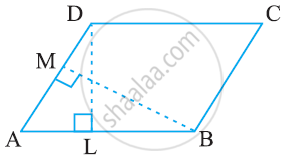
DL and BM are the heights on sides AB and AD respectively of parallelogram ABCD (see the given figure). If the area of the parallelogram is 1470 cm2, AB = 35 cm and AD = 49 cm, find the length of BM and DL.
If area of a parallelogram is 29.6 sq cm and its base is 8 cm, find its height.
Area of a parallelogram is 83.2 sq cm. If its height is 6.4 cm, find the length of its base.
Find the height ‘x’ if the area of the parallelogram is 24 cm2 and the base is 4 cm.
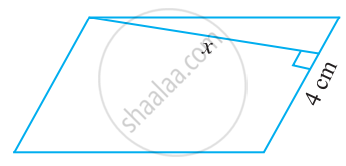
A ground is in the shape of parallelogram. The height of the parallelogram is 14 metres and the corresponding base is 8 metres longer than its height. Find the cost of levelling the ground at the rate of ₹ 15 per sq.m
The base of the parallelogram with area is 52 sq.cm and height 4 cm is
Find the missing value:
| Base | Height | Area of parallelogram |
| 15.6 cm | ______ | 16.38 cm2 |
