Advertisements
Advertisements
Question
Find the height of the parallelogram whose base is four times the height and whose area is 576 sq.cm
Advertisements
Solution
Let the height be ‘A’ and base be ‘h’ units
Given b = 4 × h
Area of the parallelogram = 576 sq.cm
b × h = 576
4h × h = 576
h × h = `576/4` = 144
h × h = 12 × 12
h = 12 cm
Height = 12 cm, base = 4 × 12 = 48 cm
APPEARS IN
RELATED QUESTIONS
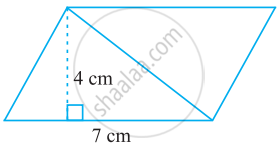
Find the area of the following parallelogram:
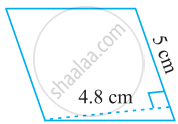
Find the area of the following parallelogram:
Find the missing value:
| Base | Height | Area of parallelogram |
| 20 cm | ______ | 246 cm2 |
If area of a parallelogram is 29.6 sq cm and its base is 8 cm, find its height.
The area of parallelogram whose base 10 m and height 7 m is
What happens to the area of the parallelogram if the base is increased 2 times and the height is halved?
The base of the parallelogram is 16 cm and the height is 7 cm less than its base. Find the area of the parallelogram
To find area, any side of a parallelogram can be chosen as ______ of the parallelogram.
If perimeter of two parallelograms are equal, then their areas are also equal.
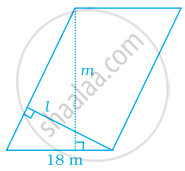
Perimeter of a parallelogram shaped land is 96 m and its area is 270 square metres. If one of the sides of this parallelogram is 18 m, find the length of the other side. Also, find the lengths of altitudes l and m (see figure).