Advertisements
Advertisements
प्रश्न
Find the height of the parallelogram whose base is four times the height and whose area is 576 sq.cm
Advertisements
उत्तर
Let the height be ‘A’ and base be ‘h’ units
Given b = 4 × h
Area of the parallelogram = 576 sq.cm
b × h = 576
4h × h = 576
h × h = `576/4` = 144
h × h = 12 × 12
h = 12 cm
Height = 12 cm, base = 4 × 12 = 48 cm
APPEARS IN
संबंधित प्रश्न
Find the area of the following parallelogram:
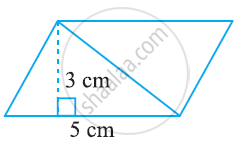
Find the missing value:
| Base | Height | Area of parallelogram |
| 20 cm | ______ | 246 cm2 |
Janaki has a piece of fabric in the shape of a parallelogram. Its height is 12 m and its base is 18 m. She cuts the fabric into four equal parallelograms by cutting the parallel sides through its mid-points. Find the area of each new parallelogram
The area of parallelogram whose base 10 m and height 7 m is
In a parallelogram the base is three times its height. If the height is 8 cm then the area is
The base of the parallelogram is 16 cm and the height is 7 cm less than its base. Find the area of the parallelogram
The height of the parallelogram is one-fourth of its base. If the area of the parallelogram is 676 sq.cm, find the height and the base
All parallelograms having equal areas have same perimeters.
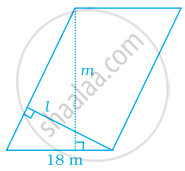
Perimeter of a parallelogram shaped land is 96 m and its area is 270 square metres. If one of the sides of this parallelogram is 18 m, find the length of the other side. Also, find the lengths of altitudes l and m (see figure).
ABCD is a parallelogram in which AE is perpendicular to CD (see figure). Also AC = 5 cm, DE = 4 cm and area of ΔAED = 6 cm2. Find the perimeter and area of ABCD.
