Advertisements
Advertisements
प्रश्न
Find the missing values.
| Base | Height | Area |
| 18 cm | 5 cm |
Advertisements
उत्तर
Given: Base 6 = 18 cm
Height h = 5 cm
Area of the parallelogram = b × h sq.units
= 18 × 5 cm2
= 90 cm2
Tabulating the results, we get
| Base | Height | Area |
| 18 cm | 5 cm | 90 cm2 |
APPEARS IN
संबंधित प्रश्न
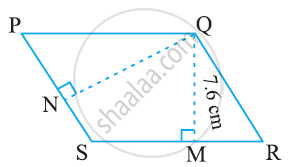
PQRS is a parallelogram (see the given figure). QM is the height from Q to SR and QN is the height from Q to PS. If SR = 12 cm and QM = 7.6 cm. Find:
- the area of the parallelogram PQRS
- QN, if PS = 8 cm
Janaki has a piece of fabric in the shape of a parallelogram. Its height is 12 m and its base is 18 m. She cuts the fabric into four equal parallelograms by cutting the parallel sides through its mid-points. Find the area of each new parallelogram
The base of the parallelogram is 16 cm and the height is 7 cm less than its base. Find the area of the parallelogram
An agricultural field is in the form of a parallelogram, whose area is 68.75 sq.hm. The distance between the parallel sides is 6.25 cm. Find the length of the base
A square and a parallelogram have the same area. If the side of the square is 48 m and the height of the parallelogram is 18 m. Find the length of the base of the parallelogram
Find the area of the parallelogram ABCD if AC is 24 cm and BE = DF = 8 cm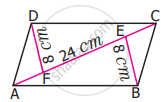
Area of parallelogram ABCD (see the figure) is not equal to ______.
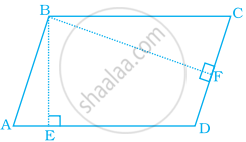
Perpendicular dropped on the base of a parallelogram from the opposite vertex is known as the corresponding ______ of the base.
If perimeter of two parallelograms are equal, then their areas are also equal.
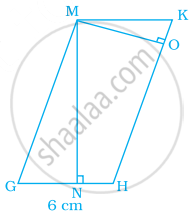
Altitudes MN and MO of parallelogram MGHK are 8 cm and 4 cm long respectively (see figure). One side GH is 6 cm long. Find the perimeter of MGHK.