Advertisements
Advertisements
प्रश्न
Perpendicular dropped on the base of a parallelogram from the opposite vertex is known as the corresponding ______ of the base.
Advertisements
उत्तर
Perpendicular dropped on the base of a parallelogram from the opposite vertex is known as the corresponding height/altitude of the base.
Explanation:
In a parallelogram, the altitude (also called the height) is the perpendicular distance between a side (called the base) and the opposite side (or the line containing the opposite side).
-
It is drawn from a vertex to the line containing the opposite side.
-
This perpendicular segment is the altitude corresponding to the base.
Example:
In a parallelogram ABCD:
-
If AB is the base, then the perpendicular drawn from C to AB (or its extension) is the altitude corresponding to AB.
APPEARS IN
संबंधित प्रश्न
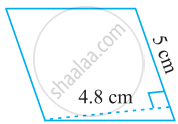
Find the area of the following parallelogram:
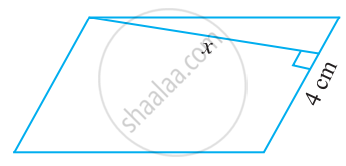
Find the height ‘x’ if the area of the parallelogram is 24 cm2 and the base is 4 cm.
Janaki has a piece of fabric in the shape of a parallelogram. Its height is 12 m and its base is 18 m. She cuts the fabric into four equal parallelograms by cutting the parallel sides through its mid-points. Find the area of each new parallelogram
A ground is in the shape of parallelogram. The height of the parallelogram is 14 metres and the corresponding base is 8 metres longer than its height. Find the cost of levelling the ground at the rate of ₹ 15 per sq.m
The area of parallelogram whose base 10 m and height 7 m is
In a parallelogram the base is three times its height. If the height is 8 cm then the area is
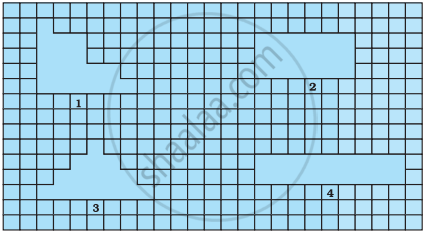
Observe the shapes 1, 2, 3 and 4 in the figures. Which of the following statements is not correct?
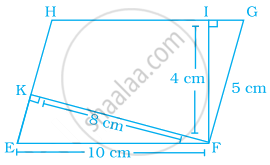
In the following figure, EFGH is a parallelogram, altitudes FK and FI are 8 cm and 4 cm respectively. If EF = 10 cm, then area of EFGH is ______.
All parallelograms having equal areas have same perimeters.
ABCD is a parallelogram in which AE is perpendicular to CD (see figure). Also AC = 5 cm, DE = 4 cm and area of ΔAED = 6 cm2. Find the perimeter and area of ABCD.
