Advertisements
Advertisements
प्रश्न
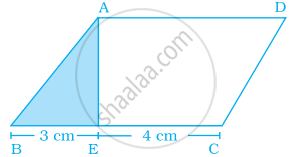
ABCD is a parallelogram in which AE is perpendicular to CD (see figure). Also AC = 5 cm, DE = 4 cm and area of ΔAED = 6 cm2. Find the perimeter and area of ABCD.
Advertisements
उत्तर
Given, area of ΔAED = 6 cm2 and AC = 5 cm and DE = 4 cm
∴ Area of ΔAED = `1/2` × DE × AE ...[∵ Area of triangle = Base × Height]
⇒ `1/2` × 4 × AE = 6
⇒ AE = `(6 xx 2)/4`
⇒ AE = 3 cm
Now, In right-angled ΔAEC,
AE = 3 cm and AC = 5 cm
So, (EC)2 = (AC)2 – (AE)2 ...[By Pythagoras theorem]
⇒ (EC)2 = 52 – 32 = 25 – 9
⇒ EC = `sqrt(16)`
⇒ EC = 4 cm
∵ DE + EC = DC
⇒ DC = 4 + 4 = 8 cm
∵ ABCD is a parallelogram.
So, AB = DC = 8 cm
Now, In right-angled ΔAED,
AD2 = AE2 + ED2 ...[By Pythagoras theorem]
⇒ AD2 = 32 + 42 = 9 + 16
⇒ AD = `sqrt(25)`
⇒ AD = 5 cm
So, AD = BC = 5 cm ...[∵ ABCD is a parallelogram]
∴ Perimeter of parallelogram ABCD = 2(l + b)
= 2(DC + AD)
= 2(8 + 5)
= 2 × 13
= 26 cm
Area of parallelogram ABCD = Base × Height
= DC × AE
= 8 × 3
= 24 cm2
APPEARS IN
संबंधित प्रश्न
Find the area of the following parallelogram:
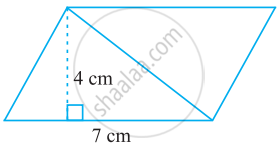
Find the area of the following parallelogram:
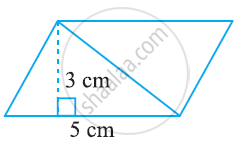
Find the area of the following parallelogram:
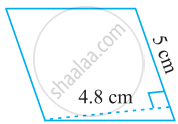
Area of a parallelogram is 83.2 sq cm. If its height is 6.4 cm, find the length of its base.
Find the height ‘x’ if the area of the parallelogram is 24 cm2 and the base is 4 cm.
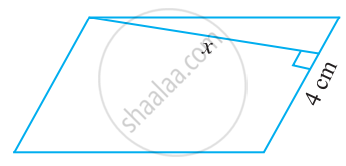
Find the missing values.
| Base | Height | Area |
| 8 cm | 56 sq.m |
Suresh on a parallelogram-shaped trophy in a state level chess tournament. He knows that the area of the trophy is 735 sq.cm and its base is 21 cm. What is the height of that trophy?
What happens to the area of the parallelogram if the base is increased 2 times and the height is halved?
Perpendicular dropped on the base of a parallelogram from the opposite vertex is known as the corresponding ______ of the base.
In the following figure, find the area of parallelogram ABCD if the area of shaded triangle is 9 cm2.