Advertisements
Advertisements
प्रश्न
Perpendicular dropped on the base of a parallelogram from the opposite vertex is known as the corresponding ______ of the base.
Advertisements
उत्तर
Perpendicular dropped on the base of a parallelogram from the opposite vertex is known as the corresponding height/altitude of the base.
Explanation:
In a parallelogram, the altitude (also called the height) is the perpendicular distance between a side (called the base) and the opposite side (or the line containing the opposite side).
-
It is drawn from a vertex to the line containing the opposite side.
-
This perpendicular segment is the altitude corresponding to the base.
Example:
In a parallelogram ABCD:
-
If AB is the base, then the perpendicular drawn from C to AB (or its extension) is the altitude corresponding to AB.
APPEARS IN
संबंधित प्रश्न
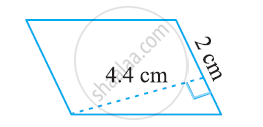
Find the area of the following parallelogram:
Find the missing value:
| Base | Height | Area of parallelogram |
| 20 cm | ______ | 246 cm2 |
A parallelogram has sides of 15 cm and 12 cm; if the distance between the 15 cm sides is 6 cm; find the distance between 12 cm sides.
The adjacent sides of a parallelogram are 21 cm and 28 cm. If it's one diagonal is 35 cm; find the area of the parallelogram.
The area of parallelogram whose base 10 m and height 7 m is
What happens to the area of the parallelogram if the base is increased 2 times and the height is halved?
In a parallelogram the base is three times its height. If the height is 8 cm then the area is
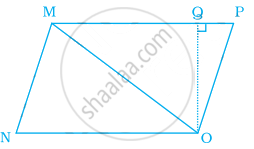
Ratio of area of ∆MNO to the area of parallelogram MNOP in the same figure is ______.
If perimeter of two parallelograms are equal, then their areas are also equal.
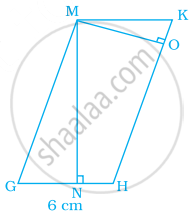
Altitudes MN and MO of parallelogram MGHK are 8 cm and 4 cm long respectively (see figure). One side GH is 6 cm long. Find the perimeter of MGHK.