Advertisements
Advertisements
प्रश्न
What happens to the area of the parallelogram if the base is increased 2 times and the height is halved?
विकल्प
Decreases to half
Remains the same
Increase by two times
None
Advertisements
उत्तर
Remains the same
Explanation;
Hint:
Area = b × h sq.units
New base = 2 × old base
New height = `1/2` × old height
New Area = New base × New height
= `(2 xx "b")1/2 xx "h"`
= bh
= old Area
APPEARS IN
संबंधित प्रश्न
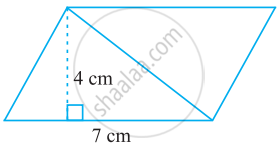
Find the area of the following parallelogram:
Find the missing value:
| Base | Height | Area of parallelogram |
| 20 cm | ______ | 246 cm2 |
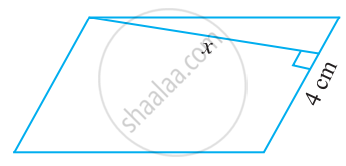
Find the height ‘x’ if the area of the parallelogram is 24 cm2 and the base is 4 cm.
Find the missing values.
| Base | Height | Area |
| 17 mm | 221 sq.mm |
The area of parallelogram whose base 10 m and height 7 m is
The base of the parallelogram with area is 52 sq.cm and height 4 cm is
A square and a parallelogram have the same area. If the side of the square is 48 m and the height of the parallelogram is 18 m. Find the length of the base of the parallelogram
The height of the parallelogram is one-fourth of its base. If the area of the parallelogram is 676 sq.cm, find the height and the base
If perimeter of two parallelograms are equal, then their areas are also equal.
ABCD is a parallelogram in which AE is perpendicular to CD (see figure). Also AC = 5 cm, DE = 4 cm and area of ΔAED = 6 cm2. Find the perimeter and area of ABCD.
