Advertisements
Advertisements
प्रश्न
To find area, any side of a parallelogram can be chosen as ______ of the parallelogram.
Advertisements
उत्तर
To find area, any side of a parallelogram can be chosen as base of the parallelogram.
Explanation:
While calculating the area of the parallelogram, we can choose any side as base.
APPEARS IN
संबंधित प्रश्न
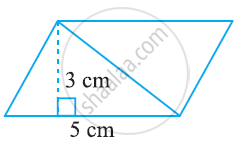
Find the area of the following parallelogram:
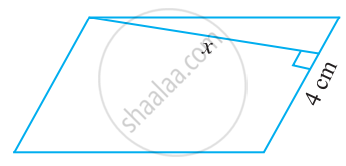
Find the height ‘x’ if the area of the parallelogram is 24 cm2 and the base is 4 cm.
The area of parallelogram whose base 10 m and height 7 m is
An agricultural field is in the form of a parallelogram, whose area is 68.75 sq.hm. The distance between the parallel sides is 6.25 cm. Find the length of the base
If the base and height of a parallelogram are in the ratio 7 : 3 and the height is 45 cm, then fixed the area of the parallelogram
Find the area of the parallelogram ABCD if AC is 24 cm and BE = DF = 8 cm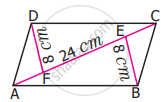
Find the height of the parallelogram whose base is four times the height and whose area is 576 sq.cm
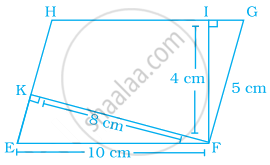
In the following figure, EFGH is a parallelogram, altitudes FK and FI are 8 cm and 4 cm respectively. If EF = 10 cm, then area of EFGH is ______.
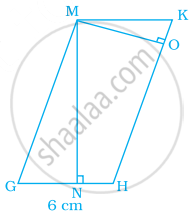
Altitudes MN and MO of parallelogram MGHK are 8 cm and 4 cm long respectively (see figure). One side GH is 6 cm long. Find the perimeter of MGHK.
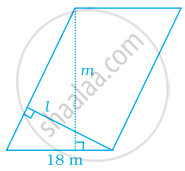
Perimeter of a parallelogram shaped land is 96 m and its area is 270 square metres. If one of the sides of this parallelogram is 18 m, find the length of the other side. Also, find the lengths of altitudes l and m (see figure).