Advertisements
Advertisements
प्रश्न
In the following figure, area of parallelogram BCEF is ________ cm2 where ACDF is a rectangle.

Advertisements
उत्तर
In the following figure, area of parallelogram BCEF is 35 cm2 where ACDF is a rectangle.
Explanation:
Area of parallelogram BCEF = Area of rectangle ACDF – Area of ΔABF – Area of ΔCDE ...[∵ Area of ΔABF = Area of ΔCDE]
= `10 xx 5 - 2 xx (1/2 xx 3 xx 5)` ...[∵ Area of triangle = `1/2` × Base × Height and Area of rectangle = Length × Breadth]
= 50 – 15
= 35 cm2
APPEARS IN
संबंधित प्रश्न
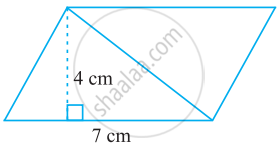
Find the area of the following parallelogram:
If area of a parallelogram is 29.6 sq cm and its base is 8 cm, find its height.
Find the missing values.
| Base | Height | Area |
| 18 cm | 5 cm |
The area of parallelogram whose base 10 m and height 7 m is
An agricultural field is in the form of a parallelogram, whose area is 68.75 sq.hm. The distance between the parallel sides is 6.25 cm. Find the length of the base
If the base and height of a parallelogram are in the ratio 7 : 3 and the height is 45 cm, then fixed the area of the parallelogram
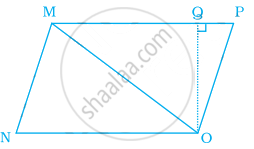
Ratio of area of ∆MNO to the area of parallelogram MNOP in the same figure is ______.
If the sides of a parallelogram are increased to twice its original lengths, how much will the perimeter of the new parallelogram?
If perimeter of two parallelograms are equal, then their areas are also equal.
ABCD is a parallelogram in which AE is perpendicular to CD (see figure). Also AC = 5 cm, DE = 4 cm and area of ΔAED = 6 cm2. Find the perimeter and area of ABCD.
