Advertisements
Advertisements
Question
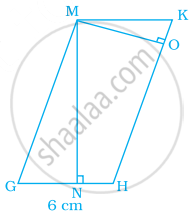
Altitudes MN and MO of parallelogram MGHK are 8 cm and 4 cm long respectively (see figure). One side GH is 6 cm long. Find the perimeter of MGHK.
Advertisements
Solution
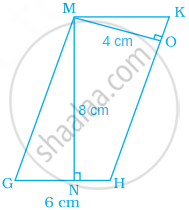
Given, MGHK is a parallelogram, where MN = 8 cm, MO = 4 cm and GH = 6 cm
∴ Area of parallelogram MGHK, when base is GH ...[∵ Area of parallelogram = Base × Height]
= GH × MN
= 6 × 8 cm2
= 48 cm2 ...(i)
Area of paralielogram MGHK, when base is HK
= HK × MO
⇒ 48 = HK × 4 ...[From equation (i)]
⇒ HK = `48/4`
⇒ HK = 12 cm
In parallelogram, opposite sides are equal.
So, GH = MK = 6 cm and MG = HK = 12 cm
∴ Perimeter of parallelogram MGHK = (6 + 6 + 12 + 12) cm = 36 cm.
APPEARS IN
RELATED QUESTIONS
Find the missing value:
| Base | Height | Area of parallelogram |
| 20 cm | ______ | 246 cm2 |
If area of a parallelogram is 29.6 sq cm and its base is 8 cm, find its height.
Area of a parallelogram is 83.2 sq cm. If its height is 6.4 cm, find the length of its base.
A parallelogram has sides of 15 cm and 12 cm; if the distance between the 15 cm sides is 6 cm; find the distance between 12 cm sides.
A parallelogram has sides of 20 cm and 30 cm. If the distance between its shorter sides is 15 cm; find the distance between the longer sides.
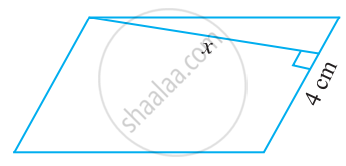
Find the height ‘x’ if the area of the parallelogram is 24 cm2 and the base is 4 cm.
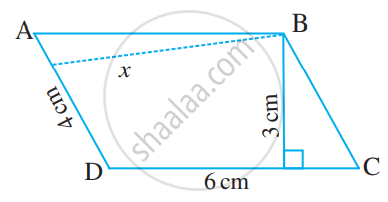
The two sides of the parallelogram ABCD are 6 cm and 4 cm. The height corresponding to the base CD is 3 cm.
Find the
(i) area of the parallelogram.
(ii) the height corresponding to the base AD.
The base of the parallelogram with area is 52 sq.cm and height 4 cm is
Find the height of the parallelogram whose base is four times the height and whose area is 576 sq.cm
Perpendicular dropped on the base of a parallelogram from the opposite vertex is known as the corresponding ______ of the base.
