Advertisements
Advertisements
प्रश्न
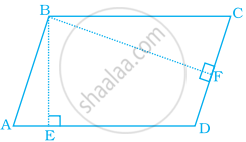
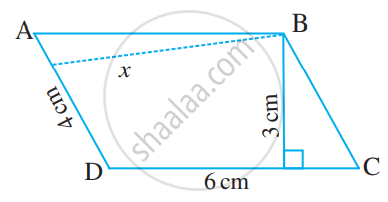
Area of parallelogram ABCD (see the figure) is not equal to ______.
पर्याय
DE × DC
BE × AD
BF × DC
BE × BC
Advertisements
उत्तर
Area of parallelogram ABCD (see the figure) is not equal to DE × DC.
Explanation:
We know that,
Area of parallelogram = Base × Corresponding height
So, area of parallelogram ABCD = AD × BE = BC × BE ...[∵ AD = BC]
or area of parallelogram ABCD = DC × BF
APPEARS IN
संबंधित प्रश्न
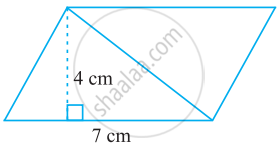
Find the area of the following parallelogram:
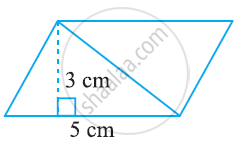
Find the area of the following parallelogram:
Find the missing value:
| Base | Height | Area of parallelogram |
| 20 cm | ______ | 246 cm2 |
The adjacent sides of a parallelogram are 21 cm and 28 cm. If it's one diagonal is 35 cm; find the area of the parallelogram.
The two sides of the parallelogram ABCD are 6 cm and 4 cm. The height corresponding to the base CD is 3 cm.
Find the
(i) area of the parallelogram.
(ii) the height corresponding to the base AD.
Find the missing values.
| Base | Height | Area |
| 17 mm | 221 sq.mm |
Janaki has a piece of fabric in the shape of a parallelogram. Its height is 12 m and its base is 18 m. She cuts the fabric into four equal parallelograms by cutting the parallel sides through its mid-points. Find the area of each new parallelogram
The area of parallelogram whose base 10 m and height 7 m is
To find area, any side of a parallelogram can be chosen as ______ of the parallelogram.
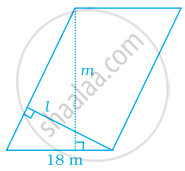
Perimeter of a parallelogram shaped land is 96 m and its area is 270 square metres. If one of the sides of this parallelogram is 18 m, find the length of the other side. Also, find the lengths of altitudes l and m (see figure).