Advertisements
Advertisements
प्रश्न
Area of triangle MNO in the following figure is ______.

पर्याय
`1/2` MN × NO
`1/2` NO × MO
`1/2` MN × OQ
`1/2` NO × OQ
Advertisements
उत्तर
Area of triangle MNO in the following figure is `underlinebb(1/2 NO xx OQ)`.
Explanation:
MNO is a triangle
We know that, area of triangle = `1/2` (base × height)
= `1/2` × NO × OQ
APPEARS IN
संबंधित प्रश्न
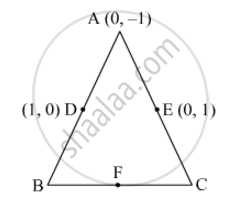
In Fig. 6, ABC is a triangle coordinates of whose vertex A are (0, −1). D and E respectively are the mid-points of the sides AB and AC and their coordinates are (1, 0) and (0, 1) respectively. If F is the mid-point of BC, find the areas of ∆ABC and ∆DEF.
In each of the following find the value of 'k', for which the points are collinear.
(8, 1), (k, -4), (2, -5)
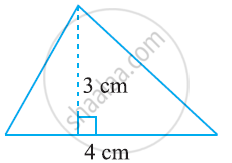
Find the area of the following triangle:
If G(–2, 1) is the centroid of a ΔABC and two of its vertices are A(1, –6) and B(–5, 2), find the third vertex of the triangle.
Show that the points A(3, 1), B(0, –2), C(1, 1) and D(4, 4) are the vertices of a parallelogram ABCD.
Find the area of the following triangle:

If the sides of a triangle are 3 cm, 4 cm and 5 cm, then the area is
Find the area of the triangle whose vertices are (–8, 4), (–6, 6) and (–3, 9).
The points A(2, 9), B(a, 5) and C(5, 5) are the vertices of a triangle ABC right angled at B. Find the values of a and hence the area of ∆ABC.
The dimensions of a rectangle ABCD are 51 cm × 25 cm. A trapezium PQCD with its parallel sides QC and PD in the ratio 9 : 8, is cut off from the rectangle as shown in the following figure. If the area of the trapezium PQCD is `5/6` th part of the area of the rectangle, find the lengths QC and PD.

