Advertisements
Advertisements
प्रश्न
When the non-parallel sides of a trapezium are equal then it is known as
विकल्प
a square
a rectangle
an isosceles trapezium
a parallelogram
Advertisements
उत्तर
When the non-parallel sides of a trapezium are equal then it is known as an isosceles trapezium
APPEARS IN
संबंधित प्रश्न
Find the area, in square metres, of the trapezium whose bases and altitude is as under:
bases = 8 m and 60 dm, altitude = 40 dm
Find the area, in square metres, of the trapezium whose bases and altitude is as under:
bases = 150 cm and 30 dm, altitude = 9 dm.
The area of a trapezium is 91 cm2 and its height is 7 cm. If one of the parallel sides is longer than the other by 8 cm, find the two parallel sides.
Find the area of a trapezium whose parallel sides are 25 cm, 13 cm and the other sides are 15 cm each.
If the area of a trapezium is 28 cm2 and one of its parallel sides is 6 cm, find the other parallel side if its altitude is 4 cm.
In Fig. 20.38, a parallelogram is drawn in a trapezium, the area of the parallelogram is 80 cm2, find the area of the trapezium.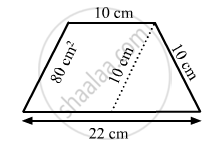
Find the area enclosed by each of the following figures [Fig. 20.49 (i)-(iii)] as the sum of the areas of a rectangle and a trapezium: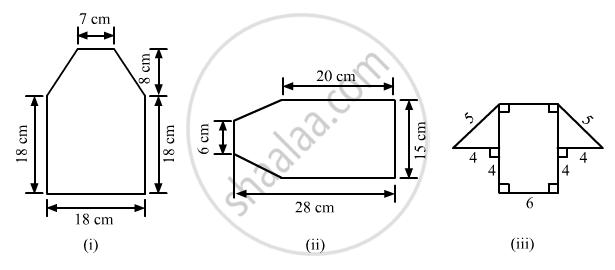
Find the area of the trapezium ABCD in which AB || DC, AB = 18 cm, ∠B = ∠C = 90°, CD = 12 cm and AD = 10 cm.
The area of the trapezium, if the parallel sides are measuring 8 cm and 10 cm and the height 5 cm is
A ground is in the form of isosceles trapezium with parallel sides measuring 42 m and 36 m long. The distance between the parallel sides is 30 m. Find the cost of levelling it at the rate of ₹ 135 per sq.m
